Field Debrief Podcast | Episode 2, Part 2
Safety-I, Safety-II, and Risk Optimization for Outdoor Programs
Featuring Steve Smith, founder of Experiential Consulting and author of Beneficial Risks and Safety Science for Outdoor & Experiential Education
By George Bull ·
In Part 1 of this two-part episode, Steve and George discussed a van incident on a muddy BLM road in Utah and how it relates to the blame cycle, safety clutter, and the lingering effects of Taylorism.
Part 2 builds on those concepts, opening with a question: if immediately after an incident is not the moment to change your safety philosophy, what can an organization do ahead of time to get out of the blame cycle?
From there: rules versus guidelines, why "safety is our top priority" is a platitude that sidesteps the real conversation, risk optimization, Safety-I and Safety-II, the zero-incident paradox, Boeing's 737 MAX and the Aviation Safety Reporting System, why the Association of Canadian Mountain Guides' incident reporting system failed, liability avoidance versus operational safety, and what an outdoor industry version of ASRS would need. Steve closes by flipping the microphone and asking George how safety science shaped Field Risk OS.
Prefer audio? Listen on Apple Podcasts or Spotify.
Topics
- Breaking the blame cycle.
- Rules, policies, and SOPs: if everything is a priority, nothing is a priority.
- Is safety really your top priority? Should it be?
- Risk optimization, and risk management as a tool to expand your program and increase capacity.
- Safety-I and Safety-II defined, and why the outdoor industry is well suited for Safety-II.
- The zero-incident paradox.
- Boeing 737 MAX and the MCAS accidents.
- Why the Association of Canadian Mountain Guides' incident reporting system failed.
- How safety science helps shape Field Risk OS.
Meet Steve Smith
Steve Smith is the founder of Experiential Consulting, LLC and has worked in outdoor education for more than 30 years. He's held positions with Outward Bound and the Student Conservation Association, where he served as national risk management director. Steve chaired the Wilderness Risk Management Conference from 2014 to 2016 and has served on accreditation and risk management committees across the industry. Today he and his team consult exclusively with outdoor and experiential education programs, from camps and guide services to outdoor education and wilderness therapy organizations. Steve is the primary author of Beneficial Risks and Safety Science for Outdoor & Experiential Education, and the host of the Were We Lucky or Were We Good? podcast. He holds a master's degree in teaching English and a Professional in Human Resources certification, and lives in Langley, Washington. As Steve puts it, his team likes to do safety with people, not to people. Steve Smith was also featured in Part 1.
Key Diagrams from the Episode
Illustrations in this episode are from Safety Science for Outdoor & Experiential Education, used with Steve's permission.
The New View of Safety
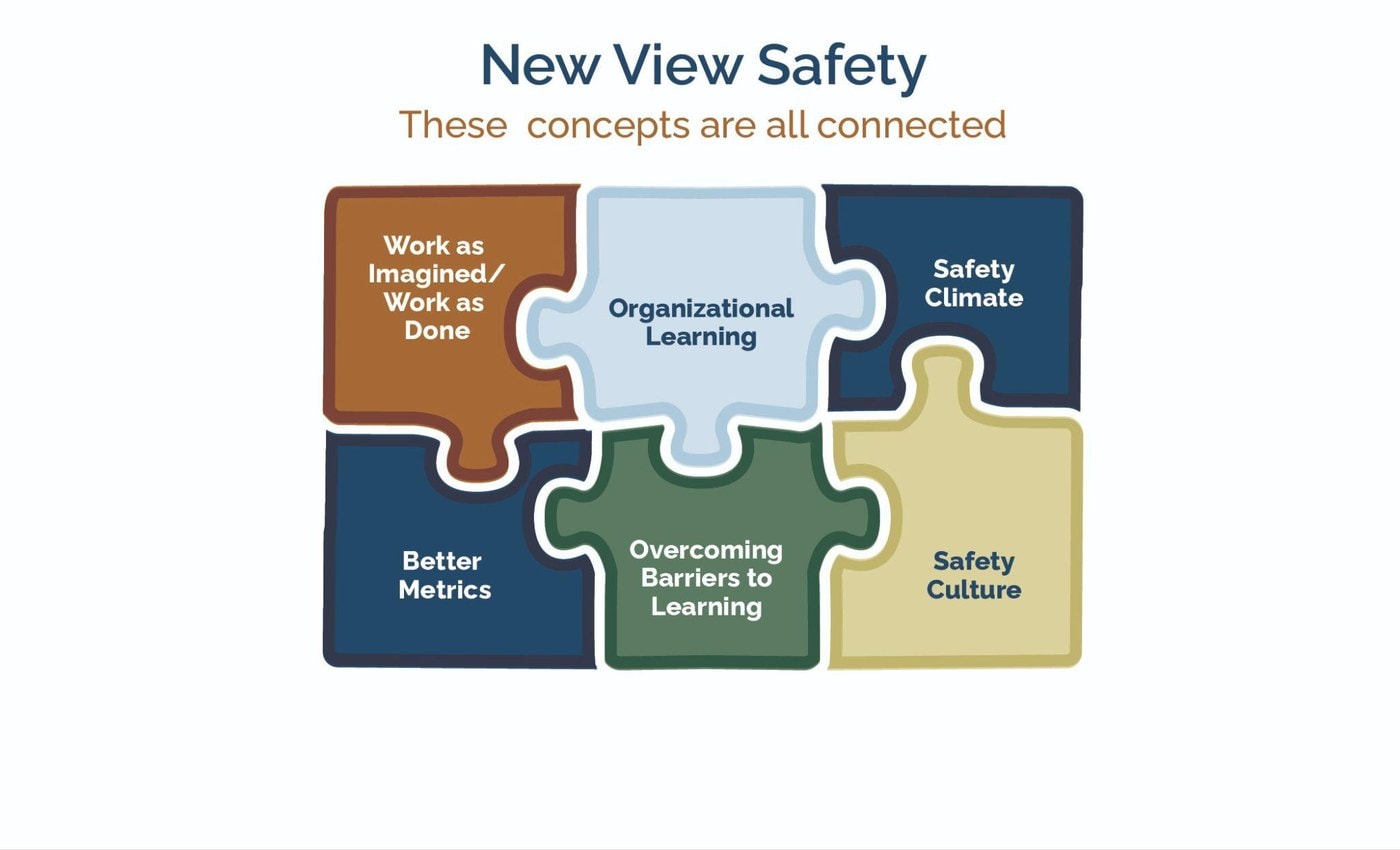
Steve's book groups the ideas behind the new view of safety as connected puzzle pieces: work as imagined and work as done, organizational learning, safety climate, better metrics, overcoming barriers to learning, and safety culture. The new view, which includes Safety-II, Safety Differently, and Human and Organizational Performance, starts from the belief that people are the solution to safety problems rather than the cause. It is the frame for everything in this half of the conversation.
Safety-I and Safety-II
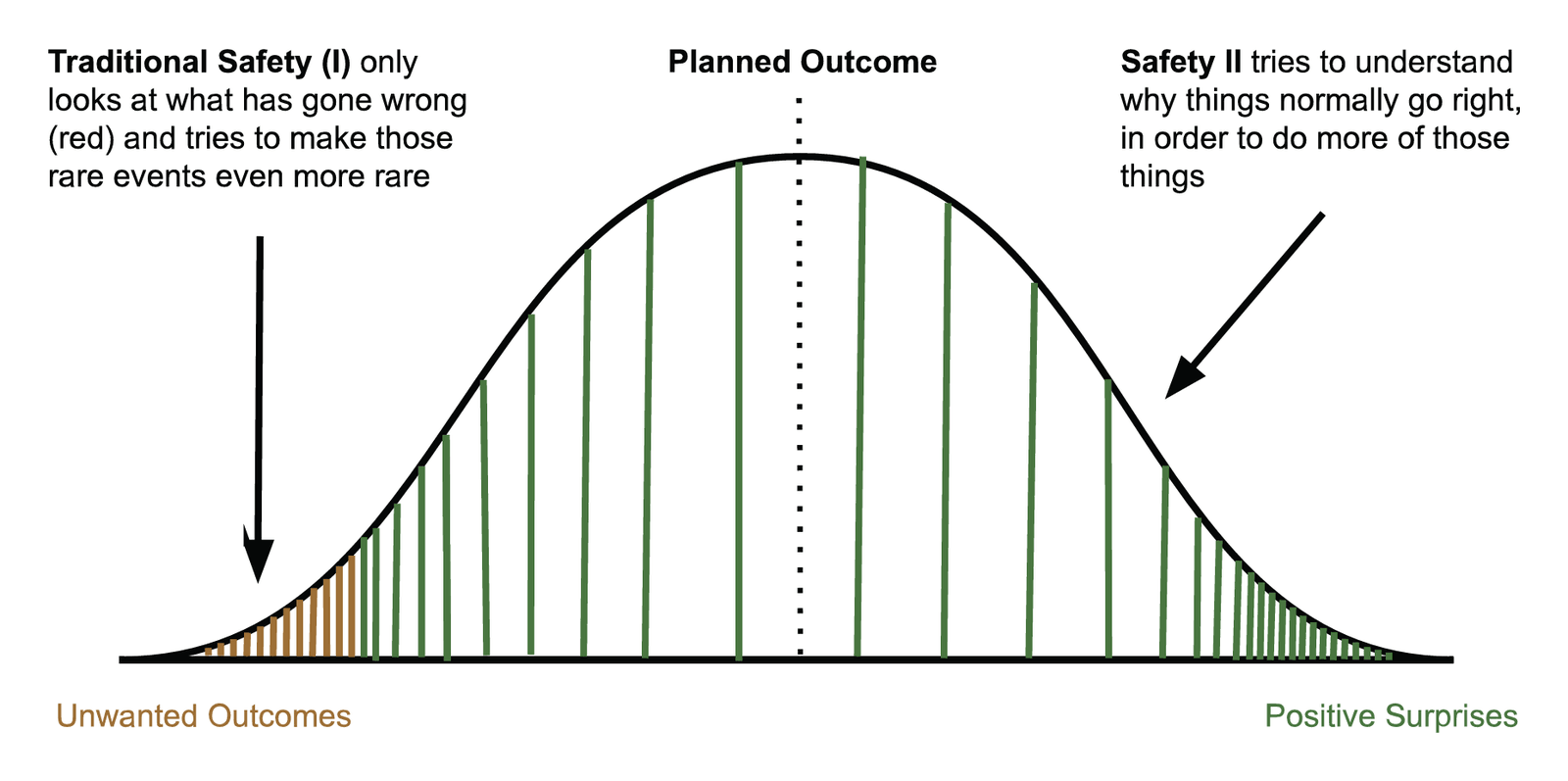
Picture the outcomes of everyday work as a bell curve. Traditional safety, Safety-I, only looks at the thin tail of unwanted outcomes and tries to make those rare events rarer. Safety-II tries to understand why things normally go right, across the whole curve, in order to do more of that. As Steve says in the episode, Safety-I is not going away. The question is how to add Safety-II.
The 737 MAX and MCAS
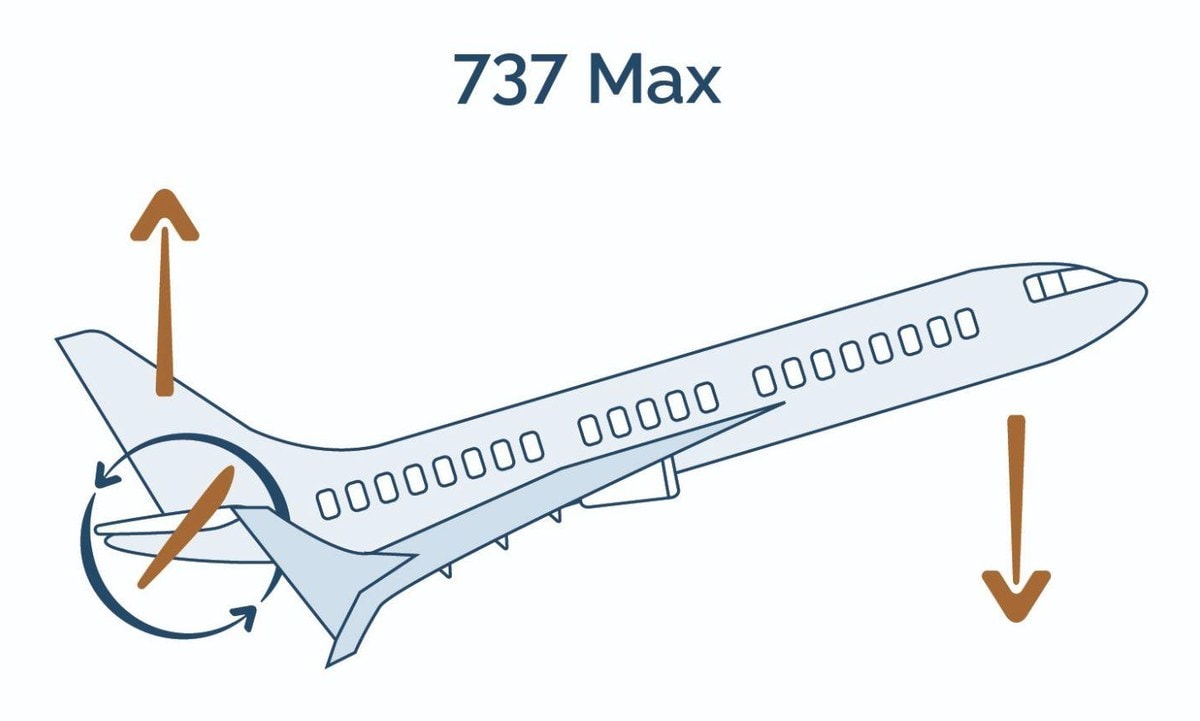
Steve's book uses the two Boeing 737 MAX crashes as a case study. The Maneuvering Characteristics Augmentation System (MCAS) was designed to push the nose down automatically when the aircraft's angle of attack got too high. Fed bad data by a faulty sensor, it kept pushing. In the months between the Lion Air crash in October 2018 and the Ethiopian Airlines crash in March 2019, US pilots filed ASRS reports describing the aircraft unexpectedly pitching nose down shortly after takeoff. That is the example that prompted the question at the center of this episode: why does the outdoor industry have nothing like it? For the human factors side of an airline accident, listen to Episode 1 on Airblue Flight 202.
The Aviation Safety Reporting System
The Aviation Safety Reporting System (ASRS) is the confidential, voluntary reporting system that lets pilots, air traffic controllers, mechanics, dispatchers, and cabin crew report safety incidents without fear of enforcement. Since 1976 it has collected more than two million reports and turned them into de-identified data, research, and safety bulletins for the whole industry.
Clarification: In this episode George refers to the Aviation Safety Reporting System as an FAA tool. ASRS is funded by the FAA but administered by NASA as an independent third party.
How Safety Science Shapes Field Risk OS
Near the end of the episode, Steve asks George a question: how does safety science shape Field Risk OS? Safety science influences the platform in numerous ways, but two in particular were discussed in this episode.
The first is safety clutter as a design constraint. Complexity reduces people's inclination to report. If filing a near miss means a full incident report form, you will not get near misses at a rate you can learn from. So Field Risk OS is built around documentation that is quick to complete, like a near-miss report a trip leader can file from a phone in the passenger seat on the way back from the trailhead, before it slips out of mind.
The second is Safety-II, or learning from everyday work. A well-run outdoor program naturally generates artifacts: good debriefs, good incident reporting, a communication log when a trip leader calls from the field. Over the course of the work you do anyway, you are generating a lot of information for your organization, and pretty often that data ends up in a binder in a filing cabinet somewhere, and you never look at it. A well-run outdoor program that uses Field Risk OS can more easily learn from those artifacts. The next time you plan that trip, relevant information is surfaced so you can actually learn from it. Everyday non-incident things get turned into lessons for the future. Imagine a decade of an organization on the platform: that learning is accessible to your 22-year-old trips coordinator on their first day on the job. Instead of just looking at a line on a map, they are looking at stories.
"So you're describing sort of a structural way for us to aggregate, funnel, collect, and see the learning from everyday work. What you're doing is you're creating a crab pot to catch institutional memory rather than letting it just disperse out into the ecosystem."
- Steve's reaction
People and Organizations Mentioned in This Episode
- Erik Hollnagel: Danish safety researcher and professor whose 2014 book Safety-I and Safety-II: The Past and Future of Safety Management gave the field the two-paradigm framing Steve uses in this episode. He is also one of the founders of resilience engineering.
- Sidney Dekker: professor at Griffith University and author of Safety Differently. He wrote the forewords to both of Steve's books. More on Dekker, James Reason, and the safety clutter researchers in Part 1.
- The Association of Canadian Mountain Guides (ACMG): the professional body that trains and certifies mountain guides in Canada. Its Incident Reporting and Learning System launched in 2018 so guides could anonymously share less serious incidents and learn from each other. The association later suspended it after its liability insurers and their lawyers advised that it would undermine their ability to defend the ACMG in the event of a lawsuit.
- The Wilderness Risk Management Conference (WRMC): the annual conference Steve cites as the model for organizations that compete for students, funding, and staff choosing to share safety practices anyway. George will be exhibiting Field Risk OS at the WRMC in Portland, Oregon, October 20 to 22, 2026.
Resources and Further Reading
- Experiential Consulting: Steve's consultancy, and where to find Beneficial Risks and Safety Science for Outdoor & Experiential Education. The illustrations in this episode are from Safety Science.
- The NASA Aviation Safety Reporting System: the program site, with the searchable database and the monthly CALLBACK bulletin.
- ASRS: The Case for Confidential Incident Reporting Systems (NASA ASRS Pub. 60): the design argument for a confidential, third-party reporting system, in the program's own words.
- From Safety-I to Safety-II: A White Paper (Hollnagel, Wears, and Braithwaite, 2015): the short, readable introduction to the two paradigms.
- Sidney Dekker's site: books and resources on Safety Differently and Just Culture.
- "When Things Go Wrong in the Mountains, Secrecy Sets In" (The Tyee, May 2024): reporting on the suspension of the ACMG's incident reporting and learning system.
- "Pilots Voiced Concerns to Federal Database About Boeing 737 Max 8 Jets" (NPR, March 2019): the ASRS reports filed between the two crashes.
- The Lucky or Good podcast: Steve's show, listed on Apple Podcasts as Were We Lucky, or Were We Good?, where outdoor programs unpack incidents, near misses, and success stories and ask whether they were lucky or good.
- Episode 2, Part 1: Blame, Accountability, and Trust: the first half of this conversation.
Field Debrief™ is produced by Field Risk Systems™ LLC, the company behind Field Risk OS™, The Operating System for Expedition Programs.
More from Field Debrief
- Blame, Accountability, and Trust: Episode 2, Part 1 with Steve Smith
- Airblue Flight 202: A Human Factors Disaster
- ICS Form 201: A Shared, Scalable Incident Briefing for Outdoor Programs
- My First Sat Phone Call as an Outdoor Program Manager
- Designing a Trip Planning System for Outdoor Expedition Programs
Episode Chapters
- 00:00 Getting out of the blame cycle before the incident
- 03:24 Rules, policies, and guidelines: if everything is a policy, nothing is
- 04:48 Safety-I and Safety-II: we need both
- 06:26 Hire people for the brain in their head
- 07:54 Safety is not the mission: show me your budget
- 11:16 Risk optimization and the impromptu summit
- 14:24 Us and them in the backcountry
- 15:27 Sidney Dekker, Erik Hollnagel, and the new view of safety
- 19:58 A zero-incident philosophy and the zero paradox
- 23:39 Boeing MCAS and the Aviation Safety Reporting System
- 25:35 Why the ACMG's reporting system failed
- 28:05 Liability avoidance versus operational safety
- 29:21 What an outdoor ASRS would need
- 32:22 How safety science shapes Field Risk OS
- 36:44 Learning from everyday work and the crab pot for institutional memory
- 39:42 Where to find Steve
Transcript
Recorded August 6, 2026. Lightly edited for clarity. Part 1 of the transcript covers the first half of the conversation.
George Bull (00:00): After an incident is not gonna be the time that you change your whole safety philosophy and you're able to get out of the blame cycle. And at that point, you know, insurance is involved and the lawyers are involved and there's things that are happening. But what can an organization do ahead of time to try to get out of that blame cycle?
Steve Smith (00:20): Yeah, ideally, you know, in my perfect world, the insurance folks and the attorneys would have already gone through some scenarios and practices so that we could get on the same page about these things, you know, before the event occurs, so that we're not trying to take this human, you know, systems thinking, safety science approach, and learn what that approach is in the moment of an actual event, right? So ideally you've kind of done some rehearsal or you've tried to get this into the drinking water of your organization proactively. But to answer your great question, the way that you've framed it, I would say that this idea of who is the audience for the manual and what are the assumptions that you've got when you're writing the manual? I think it's a real big question again of who gets to decide? Does this stuff come from the top down to the field as if they are you know not really part of the safety management of the organization? Or are we trying to involve people on the front lines and asking them things like what makes your job hard? What are the workarounds that you find yourselves having to engage in to get to camp before midnight? What are some things we can do that are going to help you speak up when you have a safety concern? Do we need to wait for a tragedy to occur and then learn from it? Or can we try to learn from everyday normal work every day? This is a surprising thing for a risk consultant to say, but we don't have enough fatalities and serious incidents to actually learn that much from them. They're more rare. A small organization might go years or decades, you know, between having a critical event like that. Some have never had a critical event like that. So if all we're doing is defining safety as the absence of those things, and in that absence, believing that we're doing it the right way because we didn't kill anyone last year, we're running a safe program. Is that so? So instead of looking at it that way, can we create an organizational culture and a trust loop kind of situation where we are learning all the time, we're learning every day, we're learning from the workarounds, we're asking the people on the front lines. You know, what are the places where you really feel like you need to adapt or where you feel pressure that's created by the conditions, the schedule, the screening or the policies or the equipment that we're giving you, and what can we do to support you? There's another really interesting piece, and I'd love to hear what you think about this, George. There's another set of terms that we tend to use really interchangeably in our industry. And we like to talk about these things as if they're all exactly the same. We talk about rules, policies, procedures, protocols, guidelines, what else? Things like this, right? There we go. SOPs, perfect.
George Bull (03:47): Standard operating procedures, yeah.
Steve Smith (03:52): So we use these terms interchangeably. But in my mind, if they're all policies, none of them are policies because people are still picking and choosing which ones to follow, which ones to ignore, which ones to do in what order. They're adapting to the situation. And if we can make more of a useful distinction between something that is a hard and fast policy, you will have the seatbelt on when the van is moving, you will have a helmet on when you're climbing, you will lock the carabiner when you're on the zip line. I don't know, you come up with a couple things that are expectations, but a lot of things that are really more like reminders, guidelines, something to think about, but we're gonna let you use your situational judgment and decision making in order to do what's needed to meet your outcomes with that group, with those conditions and your mission and your outcomes on that day. Isn't that beautiful? To strike that line. And that is inherently much more, if you think about how the book describes Safety-I and Safety-II, one kind of like a top-down rule-based approach as opposed to a bottom-up human-based approach. That is much more of a sort of, you know, focusing on people as solutions to our problems and believing that people have these innate, inherent adaptive abilities to, for the most part, be solutions. To use their judgment and common sense and experience to do the right things. So, you know, in writing the manual, what is your underlying belief system? Is it all Safety-I? Or do we strictly want people to follow rules at all times and never deviate from those rules? Or do we want to intentionally design the approach to have some balance? You know, and I personally believe that we need both. We need Safety-I and Safety-II. Safety-I has served us really well to get us to a certain point and it can only take us so far. So by doing both Safety-I and Safety-II, then we can really, you know, make the most of that balance between, as you nicely put it, kind of like taking care of the organization, but also optimizing and utilizing the innate adaptive capacities that the human beings in the organization bring to the table. So instead of putting them against each other, how can we use them to complement each other like that?
George Bull (06:26): I think, and I guarantee I'm not the only person who's ever had this in a trip leader manual, but the biggest sort of piece that I'm thinking about right now, after hearing what you said, is that people are really smart. Like you hire people not because, and maybe in a Tayloristic view this wouldn't be true, but like in my view, you hire people not because they can read a checklist, but because of the brain in their head. And as part of that, you need to extend to them some trust to use that brain to deliver great outcomes for their trips. And that's not only in like the safety science piece of it, but also, sometimes it's so easy to get bogged down in the safety science of it that you limit someone's ability to create a great trip. On a perfect trip, the participants don't notice safety science, right? There's no such thing as a perfect trip, but a lot of it is things like your pre-trip briefing feeling fun, and you can add a little bit of flair to that as long as you get these specific things covered. Like you don't need to read a script, right? That's gonna be not very fun for your participants. And so allowing some room for freedom there, I think, is really important, not only to safety, but also as a culture, making sure that you run great trips.
Steve Smith (07:54): Yeah, I love that observation. And you know, I'm yet to meet the organization running outdoor programs whose actual mission and goal is safety. They're not taking people down the Grand Canyon in order to make them more safe. They're not taking people mountaineering on Mount Rainier or any of the things. The pursuit of safety is actually not the goal. And we get confused about that. And we talk about well, safety is our top priority. Well, first of all, is it? I don't think it is.
George Bull (08:27): You'd be on the couch if safety was your top priority.
Steve Smith (08:29): Yeah, exactly. Or show me your budget that indicates that safety is your first priority. I don't think it is based on what I see, right? So first of all, no. And second, should it even be the priority? I think by using those platitudes by saying things like safety is our top priority, we sidestep having a more genuine and useful conversation about what is the role of risk in the program. Is risk a bad thing? This gets more to the first book, the beneficial risks book, but is risk a bad thing? You know, that we are trying to completely pressure wash out of the program altogether. As if we could remove the inherent risk of the river and the grizzly bears and the carabiners and the lightning and the ice axes and all that stuff. Or the humans, just the humans themselves, right? But is risk a bad thing that we should pressure wash completely out of the program if we could, or alternatively, and as I know you believe, you know, is there inherent benefit to risk that we can only get by embracing it, by intentionally pursuing it, by identifying what are the beneficial risks that we want from this program, and designing the program not to go away from the bad stuff, but to go towards the good stuff. You know, people do a lot better with pursuit rather than avoidance. The manual that you were describing earlier, that was written with liability in mind, is probably gonna be a litany of don'ts. Don't do this, don't do that, avoid this, don't do these things. Humans do so much better with being told what to go towards than what to not do. Don't wreck the van. Don't speed. Don't be reckless. It's like that's not helping me be safer actually. So if we give people a vision of what an effective zip lining activity looks like or what a well-designed trip down the river looks like and they can go towards that. That's going to be more of the Safety-II way of writing the manual than the Safety-I way, which is instead of avoiding the bad stuff, how can we pursue the good stuff? And what is, you know, an authentic adult style conversation about the benefits of risk, instead of saying safety is our top priority and leaving it at that. So you know, I think it's a way that our industry could evolve and could get better at that.
George Bull (11:16): Even before I read Beneficial Risks, I had always held this view, or at least as long as I can remember after being exposed to risk management through NOLS courses and things like that, that risk management shouldn't keep you from doing things. Good risk management should actually enable you to do cooler things. If you have great risk management, if you're super prepared, if you have excess capacity in your systems, that actually would be unlocking doors and making something like an impromptu summit on a beautiful morning on your backpacking trip like the right decision that makes that more possible. Whereas I think maybe the reputation that risk management or safety management has would be the people that come in and say no, don't climb that mountain. But I don't think that's my worldview of what risk management is. And I never really understood how to explain that better than what I just said. But in your book, there's that term risk optimization. Like you're not necessarily trying to manage the risk, you're trying to optimize the level of risk that you're accepting. And I think that's such a good framework for that adult conversation that you just mentioned, where you know, when you're making these decisions, the risk management decision would almost always be to not do anything. But the risk optimization decision might be: yeah, the weather looks good, we have, you know, we're well rested, like our people are in great shape, so we can handle this boulder field. Let's go do this mountain. Like that could be the risk optimization decision.
Steve Smith (13:00): Somewhere around here I have my Experiential Consulting hat that says optimizing risk on the brim of the hat. So I'll see if I can find that before we hang up and show that to folks. But I love that you brought up risk optimization. Is risk something that we want to manage or mitigate or minimize like it's a mosquito, you know, or is it something that, like as we were saying, has inherent value and benefit that we can only get by perhaps pursuing it and optimizing it. We can't eliminate it. And I've heard you say, you know, I've heard you nicely articulate that we can push risk around, and we can move it into different buckets and stuff like that. But this idea of eliminating risk or mitigating or managing, you know, I really like this framework of optimizing risk. And so I'm really glad you brought that up. It's a good thing, it's an essential thing, it's a helpful thing, if we can approach it, you know, in that way. So yeah, great, great call out, George.
George Bull (14:09): Steve, I see we took a quick break there. I see you've got your optimizing risk hat on.
Steve Smith (14:17): Yes, I'm so glad you brought that up. So it gives me a chance to show my new hat.
George Bull (14:24): That's awesome. Okay, kind of going back to that Utah van story, and how it relates a little bit to that concept of Taylorism, which I love that we've created sort of a through line on this episode with, and that kind of manager-worker relationship. Us and them, absolutely. When you think about that us and them relationship, I think something that's sort of inherently contradictory between like trying to attach an us and them relationship to the wilderness is the lack of supervision. Like you're trusting people to make those decisions in the backcountry. And so the us isn't even there. How do you reflect on that or what do you think about sort of trying to apply an us and them mentality to people that aren't in the same zip code even?
Steve Smith (15:27): Yeah, totally. Beautiful. Great question. So, you know, when I first started reading Sidney Dekker's work, the Safety Differently book, which is right here, and I was just looking at it earlier today for different reasons, I started learning about this new view of safety and what Erik Hollnagel has called Safety-I and Safety-II. Safety-I is sort of measuring safety by the absence of incidents, and it's trying to basically figure out what's wrong and do less of it. Safety-II is asking a very different question, which is why do things normally go right? And instead of seeing people as the causes of our safety concerns, seeing them as the solutions to our safety concerns. And so it's going towards something rather than away from something. One is top down, traditional OSHA style: punish people for doing the wrong thing. The other one is much more about how can we help people do the right thing. So Safety-I and Safety-II. Both are actually useful, both are important. And we're never going to get away from Safety-I. It's not going away, but the question is how can we do more? How do we add Safety-II into that and use the right strategy for the right situation? So that's a little framework to answer your great question. And you know, in outdoor and wilderness and experiential education programs, once I started understanding the new view of safety and Safety-II, and bringing that to organizations, I was pleasantly surprised at how well received this has been. And I think there are some things about our industry that is different and that is more uniquely suited to this approach than something like, say, working in a nuclear power plant, or maybe working on a nuclear submarine, or perhaps even, let's imagine, a conveyor belt style assembly line kind of a situation. So, some of the things about our workplace that's different. One, you mentioned this idea that the supervision is back at the headquarters. The supervision is somewhere else. And we are putting a great deal of trust in the instructors and the frontline workers in some remote place. And do we actually even want them to be sort of strictly following some pre-built itinerary and following rules that may not match the uniqueness of the changing weather and circumstances and dynamic conditions and the group dynamics and all the things that might be fluid and dynamic in any given moment. Of course, we know that they need to be adapting. If we don't think that they're the right people for this job, then they shouldn't be out there, right? And so there is something that's inherently a bit of Safety-II to begin with, about the place that we're doing it and the activities that we're doing and the structure of the program itself. It's already kind of like leaning in that direction. And the problem was that for the longest time we were trying to only use a Safety-I approach with something that is actually naturally quite dependent on and benefits from a Safety-II approach, and so there was this mismatch. And so over the last whatever 10 years, we've been sort of moving in this direction, and since I first started learning about Sidney Dekker's work and trying to bring it to the organizations that we work with, it's been extremely well received. Another piece that might make our programs different is, you know, if we were these risk averse people that only wanted to avoid liability and all this, we wouldn't be building these wilderness based programs and taking people on these expeditions and doing all this stuff. So there's something that inherently understands the benefits of risk to begin with. And I think we just didn't necessarily have the framework or the language or the research, you know, that backs us up in how to do it. And you know, when I first took a job working as a national risk management director at a large conservation organization that had programs operating in all 50 states, I intuitively wanted to do, and I ended up doing, a lot of the things that are described in the safety science book, but I didn't know why I was doing them. I didn't have research to explain to me why we should not just be reporting incidents, but we should also be reporting near misses and that we should be debriefing not just the things that have gone wrong, but the things that are helping stuff go right. And that we should be practicing our crisis response exercises before we have the crisis itself and stuff like this. And I did a lot of things. In that organization, we had a risk philosophy that was about zero. The goal was zero incidents. And I intuitively felt that was problematic. And I didn't exactly know why. But I wanted to work with the board and with the leadership and with the program staff and people at all levels of the organization, not just top-down, but all the different levels, to have a more adult-style conversation about: is this actually the goal? Is this the entirety of what we should be striving for in our approach to risk management, avoidance, like zero incidents? First of all, really? And second of all, is that even a good goal? And as we unpacked it and changed it, you know, I wish I had some of the research and the studies that I now know about that would have helped me do that a little bit more confidently and a little bit more efficiently, and with more reasoning behind it. This idea, the zero paradox is what it's called, is this fascinating problem where, when we pursue zero incidents, as we discussed earlier, it can drive reporting underground, it can make us less safe, it can backfire, it can be part of a blame cycle, right? And so, you know, basically, there's a lot of stuff about the field that we work in that is very receptive and conducive to all of the safety science that's in the book. But I just didn't have access to that until more recently. So it's been really exciting to see how well it's been received by folks and how they use it and how it might iterate differently for you know a conservation corps than an outdoor education program or a guide service or a wilderness therapy program, or all the different kinds of groups that we are now seeing are applying the concepts from the book. So yeah, it's a great observation, George. I love that you called out what is it that's unique about our field. I think we are the right people to be using this approach, and we see it in avalanche education, we see it in a lot of different facets of our industry.
George Bull (23:19): Yeah, the level of trust, risk, varying levels of experience. It's fascinating how we get to apply these tools from other industries. Getting back a little bit more towards Safety-I and the idea of investigating incidents after they happen, and then maybe being a little bit more forward-looking with that type of incident reporting and incident investigations. I noticed in your book that you had a chapter about the Boeing MCAS 737 crashes. Very quickly, there was a mechanical fault essentially with the Boeing 737 Max aircraft. There's a whole variety of things to unpack there, from human factors to engineering, and it's a little bit beyond the purview of my expertise, at least, to dive into on the podcast here. But there's no shortage of great information online about that. But one line in your book about these 737 accidents was that 10 pilots, it might have been a lot more than 10 even, had submitted what are called Aviation Safety Reporting System reports, ASRS reports. And these reports essentially are an incident reporting tool that lets pilots submit an incident report to the FAA. It will be anonymized, and then the FAA analyzes that information and releases reports or spots trends before things happen, and uses that to better the safety of the entire aviation industry. [Editor's note: ASRS is funded by the FAA but administered by NASA, which is what keeps the reports confidential. See the correction above.] And as soon as I read that, or as soon as I found out about ASRS (I'm a private pilot actually and have submitted an ASRS report in the past), I thought the outdoor industry should have some sort of incident reporting repository like this, where we can all learn from each other in the field. And later on that page in the book, you mentioned that the Association of Canadian Mountain Guides attempted this and it did not survive its first contact with the legal system. What do you see as the barriers? Like, why don't we have the ASRS for the outdoor industry? And what could that look like?
Steve Smith (25:35): Yeah, I'm glad you brought up that ACMG example. It's a sad story. I'm gonna give a real simple high-level version of the story, but someone died in an avalanche incident, and there was a family. And the family was hoping and asking, you know, can we create more learning between guide services? So that this kind of thing is prevented in the future, or that there can be learning between organizations. And you know, what a good idea. It's sort of like the whole spirit in which the Wilderness Risk Management Conference came together in order to create learning, you know, between organizations that compete with each other for students and funding and instructors. But we shouldn't compete on safety. We should be sharing our safety practices. And you know, the Association of Canadian Mountain Guides wanted to also create a platform for folks to share between themselves what was happening. And they got it up and running and it was working well and they were sharing, you know, near misses and differences between, you know, the avalanche forecast for the day said this, but look what happened, and can we all maybe be more aware of this particular combination of events? And you know, it was working as intended, until the insurance company that insures the association caught wind of the situation and they looked at it through the lens of what do we have to lose from this, instead of what can we gain from this? How might this litany of incident reports and near misses be used against us? And it's a really interesting example of the Safety-I lens and the Safety-II lens. What do we have to lose? How could this be used against us versus how can we improve and get better and you know, we won't have to actually pay insurance claims on incidents that are prevented. You might look at it that way, or you might look at it like if we do have an insurance claim, or if something does happen with one of these guide services, how might their previous incident reports or near misses be evidence of their failures that could be used against them? And you know, so it's a really unfortunate issue that I see that I want to frame like this: liability avoidance versus operational safety. And both are important. Both are good, but if I had to pick one, I would rather have a terrible waiver and a great program than an ironclad liability waiver and a poorly run program. So I think that in our society we often confuse liability avoidance for operational safety, and we put a lot of priority and investment and financial sort of weight around what the lawyers say and what the insurance company says, even at the expense of something like what the Mountain Guide Association was trying to do, which might be the single greatest way. We can't prevent every incident, but we can prevent learning from the incidents if we create these sort of barriers. You know, your question about what would it take for our industry to have some sort of a reporting system, I think that we would have to have the courage and the political will to make a distinction between liability avoidance and learning and operational safety. And we would have to decide which one is more important. If we strictly wanted to just get into the nuts and bolts of it, you know, I can give you a Safety-I answer to your question and a Safety-II answer to your question. So the Safety-I answer would be that we need to define what is an incident. You know, what is a near miss? What might be a near miss for a group of kindergartners would actually just be considered normal for a group of mountain guides in training up on a glacier, right? Something that's a big deal for an outdoor education program behaviorally might just be a Tuesday for a wilderness therapy program that has a very different population and behaviors that are normal. And so it would actually be kind of really hard to have a monolithic incident reporting system where everyone could universally agree what is an incident, what is a near-miss, and what is normal. Because we don't want to spend all our time reporting normal. We want to learn from normal. We want to improve from normal, but it's hard to define normal across our industry because it's so different. So that's the Safety-I answer: we need to define what it is before we can report the stuff that's going wrong. The Safety-II answer would ask a very different question. And it's more like can we move beyond just reporting these instances of unsafety? And how do we also report safety success stories, learning from everyday work? Maybe an example of something where we all recognized this workaround that was happening. We listened to the weak signals that we were getting from whatever was going on, and we changed something upstream of that before something bad happened. And we let our frontline workers be part of the safety management system and listening, honoring the expertise that they bring at that very ground level. They're the ones with their hands on the canoe paddles, you know, meeting with the students, adapting and overcoming the imperfect systems that we've provided them, and that we should have an ASRS that's not just about the bad stuff. There's a lot more good stuff than bad stuff, and how can we also tap into that as well? So, you know, in the absence of a formal reporting tool like that, you know, I think this makes things like webinars and conferences and podcasts like what you're creating, it makes our ability to listen to and learn from each other's stories so important. And I think the podcast that you've created is a really important piece of that puzzle. So it sort of brings up a question that I was gonna ask you. George, if you're ready for me to pose a question to you as the host.
George Bull (32:20): Go ahead.
Steve Smith (32:22): So I know you're working on a platform that might be part of what I'm describing, a way for organizations to have visibility into what they're doing, what others are doing to create interprogrammatic learning, or maybe just trends, you know, that are coming up between different organizations. And as your platform grows and gets adopted by more and more organizations, it might be filling the need that you're describing with the lack of an ASRS, right? So I'm wondering in designing that and thinking about your hopes and dreams for the future of that platform, are there any safety science concepts that we've talked about today or other ones from reading or research that you've done that you have integrated into how you think about the way that platform is going to work for people?
George Bull (33:14): Yeah, absolutely. The piece you just described is something that's on my mind for down the line in the future. Like you mentioned earlier, sort of a paradoxical challenge in our industry is that individual organizations don't have that big of a sample size to learn from a lot of the times. And so with a platform like Field Risk OS and like building a community around that, eventually your sample size is gonna be a lot larger, and you're gonna be able to learn lessons from more organizations that have the same type of data. But sort of where I am right now with designing and building the system, I think there's sort of two areas that safety science is really involved. And I'll start by couching this with: Field Risk OS is not a safety application. And I don't think there's really any, I don't know, maybe someone else has built one, but certainly my design philosophy is not that doing things on a computer is the risk management. Those tools can help you increase your capacity for safety, increase your situational awareness. And so I just want to mention like the platform itself isn't doing the risk management. That's still always between your ears. That's an organization and its people doing that risk management. But I think when we talk about like safety clutter, for example, that's a core design principle of mine, is reducing safety clutter. And every single piece of documentation that's in Field Risk OS is designed around making it easy and efficient. I think when we talk about things like incident reporting and near misses, complexity reduces people's inclination to do those things, to file an incident report, to file a near miss. And so tools like a 60-second near-miss report that you can do from your phone in the van, in the passenger seat back from the trailhead, is gonna collect a lot of data, whereas once that trip leader gets back, they might not, you know, they get busy. They're unpacking the trip. Probably that near miss is gonna slip out of their mind and you're not gonna learn from that. And then I think just inherently from the Safety-II perspective. If you want to learn more about Field Risk OS, you can go to the Field Risk OS website, but generally, it's a platform that you use to manage your outdoor expedition program. And just over the course of the work that you do anyway, as far as like good debriefs, good incident reporting, doing a communication log when a trip leader calls from the field, you're actually generating a lot of information for your organization. I think it's pretty often that maybe your data, like your call sheet, for example, might end up in a binder in a filing cabinet somewhere, and you never look at it. But that call sheet might have said something like, you know, it took us really long to get through this valley because the trail's really bad. And then maybe during the debrief, the trip leader described the game trail that they found that was a way better way to get through that valley or something like that. And with a platform like Field Risk OS, the next time you plan that trip, that information is in the trip plan. Like it's being surfaced at the time that you're actually gonna learn from it. And so I think there's an inherent Safety-II-ness to the idea of like taking those everyday non-incident things and turning those into lessons in the future.
Steve Smith (36:44): I love how you framed that, George, and you know, to me that second one especially really just circles back to that idea of learning from everyday work and not waiting for some bad thing to happen. If the Safety-I part of it is counting the things that have gone wrong and quantifying, the Safety-II version of what you described is more the qualitative stuff, the stories, the things that almost happened. What can we learn from this year that isn't an incident, it isn't a document, but it's something that we want to create learning for next year. And it's the stuff that hides in and around the cracks. If all we do is debrief and focus on the stuff that's broken, we miss all that learning from all that other stuff. So you're describing sort of a structural way for us to aggregate and funnel and collect and see the learning from everyday work. So is that fair? Am I getting that right?
George Bull (37:41): Yeah, I think you're just about spot on there, Steve.
Steve Smith (37:44): Nice. And I love the idea of a group next year benefiting from something. You know, you might lose people. That's one of our things in our field, a person leaves the organization and a lot of institutional memory goes with that person, whether it's a field instructor or maybe the program person that's been there for 30 years and they retire and all that institutional memory goes away. And so what you're doing is you're creating a crab pot to catch institutional memory rather than letting it just disperse out into the ecosystem. So, you know, it's a really strange metaphor that I just offered you, but I think it works for me.
George Bull (38:29): No, I appreciate it. That's definitely something I think about a lot when I'm designing. It's so cool. When I was a trips manager, it would have been so cool for me to go into a trip template and scroll down and see the debrief from a prior trip that a trip leader found a great river crossing spot. You know, and that person has left the organization and I don't even know their name, but I can still learn from like the little tidbits. And over the course of, you know, imagine a decade of an organization being on this platform, you'd have so much learning that is then accessible to your 22-year-old trips coordinator on their first day on the job, when you're like, hey, let's go over some trips. Instead of just looking at a line on a map, you're looking at stories. And that's pretty cool.
Steve Smith (39:17): Nice. Awesome. Well, I can't wait to see what you're working on and how organizations are using it and how it might add some momentum to a lot of the safety science stuff we talked about on this episode and a lot of what the research tells us. We don't have to work harder, we can work smarter. And how might, you know, your platform help people with that. So really looking forward to seeing what you do with it.
George Bull (39:42): Thanks, Steve. And if people are looking to find what you're working on, where can they find you?
Steve Smith (39:47): Couple places. So outdoorrisk.com would be a good place to go to just generally learn about the consulting company and who we are and what we do. We are a risk management consultancy, a team of eight of us at the moment that uniquely works with outdoor and experiential education programs on their risk management strategies. We like to do safety with people, not to people, and we like to apply these safety science concepts in pursuit of the beneficial risks of your programs. So that's a good place to look and I happen to have a podcast too, George, which is the Lucky or Good podcast. And that's a place where we try to have outdoor programs come on and unpack stories, incidents, events, near misses, or success stories, and ask this question of were we lucky or were we good? And for us not to confuse those two things, because I think that's a common human tendency. You know, when things go well, we like to believe that we were good. And when things go badly, we like to believe that we were unlucky. But it can be the opposite. We can be getting by on luck, and how do we convert our lucky situation into good for the future and not confuse those things? So there's a couple places people might look, and you can also learn about the books on the Outdoor Risk website as well. So yeah, thanks so much.
George Bull (41:17): Awesome. Yeah, thanks for coming on, Steve.