My First Sat Phone Call as an Outdoor Program Manager
What a scribbled communications log sheet taught me about incident communications for outdoor expedition programs, and how a sat phone call shaped the communications log feature in Field Risk OS.
By George Bull ·
"This is John on Grizzly Peak Backpack with a medical sat phone call."
I'm changing some of the names and details of this incident, but those were the words that started the very first sat phone call I answered as an outdoor program manager. I was the backcountry education and training manager for a summer camp in Wyoming, a program running serious multi-day expeditions across the Greater Yellowstone Ecosystem. The next phrases from the other end of that call included "severe chest pain" and "trouble breathing." Those words increased my heart rate and stress levels in a way that I couldn't feel in the moment, but would become a learning experience as the incident evolved later that night.
The situation was resolved with no injuries or negative outcomes for those involved, and many lessons learned.
But first, who am I, and why am I writing about wilderness communication logs?
I've been working in the outdoor industry for about six years. My first role in the industry was as a trip leader for that same camp in Wyoming, leading backcountry expeditions in the Tetons, Winds, and Gros Ventre mountains.
My third season, I stepped into the role of backcountry education and training manager. My job was to lead trip leader training, help with risk management and SOP development, and take supervised shifts in our incident command and on-call coverage structure. My supervisor (the backcountry trips manager), along with the organization's executive director, were great mentors. They were passionate about incident response systems and patient with me as I learned how to run a response from the office. I'd eventually step into the backcountry trips manager role for a future season. Since then, I've served as a deep field coordinator for the US Antarctic Program and guided remote expeditions in Alaska.
This story is from that third season, and my first as an outdoor program manager.
The Call
Our sat phone protocol was deliberate and scripted because sat phones can be unreliable. Service is inconsistent, especially in the mountains, and you might only have thirty seconds or a couple of minutes before the connection drops. For a trip leader managing an active situation, that one call might be the only window they get, so the information has to be dense, organized, and delivered in a predictable pattern that both sides have practiced. At this organization, that pattern was simple: who I am, what trip I'm on, and what type of call: medical, behavioral, logistics, or other.
It was about nine or ten o'clock at night. A trips program coordinator and I were in the office winding down for the evening. It was the first week of that summer's program, actually one of the first nights. Quiet. Things were going smoothly.
And then the office phone rang.
"This is John on Grizzly Peak Backpack with a medical call."
I had been in the room for several medical sat phone calls before. But this was the first one I was running and expected to lead the response on to get feedback from the program leadership team afterward. My name was on the on-call system.
The call's opening was followed with a SOAP (subjective, objective, assessment, plan) note about a staff member on the trip, containing "severe chest pain" and "trouble breathing." Hearing those words elevated my heart rate and stress levels in a way I didn't fully realize in the moment. I had been taught to keep it low and stay calm, to be the calming presence on the phone. John was on his very first trip with participants. I had been in his shoes a couple of years before. There can be a lot of pressure on your first trip as a leader, and understandably so. You're responsible for other people's children in the backcountry.
Chest pain and trouble breathing can mean a lot of things, the worst of which are very serious. The gears in my head were already spinning, and fast.
We had call sheets, a structured sat phone call log for capturing the information from the field. I pulled one out, grabbed my pen, and started writing while listening to his report. The trip was on the property of the organization, a five- or ten-minute Jeep ride. We had a nurse on site. So while I was writing, I was also already thinking through the response plan: what needed to happen next, who was going where.
The call ended. I gave a quick report to the trips coordinator and handed him the call sheet, grabbed the nurse, she grabbed the go bag, and we jumped in the Jeep.
On Scene
We got there within ten minutes. The trip leaders were visibly stressed, but the situation was clearly less serious than the call had suggested. We assessed the staff member, and talked with the trip leaders. Everyone was fine.
We spent about thirty minutes with the group, making sure everything was settled down, doing some coaching with the trip leaders about how the specific words you use in a SOAP note or a sat phone call carry real meaning. Those words are going to affect how the person on the other end of the line responds. Good learning experience all around. Then I drove back to the office.
Back at the Office
I got back about an hour after I'd left. Walking into the office, I found the trips leadership team and executive director, five people, sitting in the office, looking at me.
I gave the quick report: everything's okay, no next steps tonight, full debrief tomorrow, incident report needs to be filed when the trip gets back.
My mentor and supervisor, the trips program manager at the time, had my sat phone call sheet in his hand. He looked at me and handed it back.
"Hey George, can you read this?"
I looked down at the call sheet I had written. The clearest word on the page was "severe" and I could kind of make out "chest pain" and the trip leader's name. The rest: scribbles. Essentially gibberish.
During the call, my heart rate was higher than I realized and I was multitasking: listening, writing, already planning the response. And my brain thought I was putting legible words on paper. I wasn't.
And then it clicked. For an hour, the rest of the leadership team had been sitting in that office without a current picture of the situation. I had it handled in the field, and I would have called for help had I needed it, but from the office they had no way of knowing that. The night could have been a helicopter evacuation or a cup of hot cocoa, and they had no way to tell which. I had communication tools with me (radios and a sat phone), but the radios didn't reach where we were, and once I got on scene and found the situation calm and manageable, I was focused on the situation at hand. I didn't pull the sat phone out and update the office.
While I was in the field, relieved everything was fine, they were still in the office with the worst version of the story in their heads.
Two Lessons Learned
1. The Idea of Being Calm Is Different from the Reality of Being Calm.
You can know the protocol back to front and still have your physiology work against you, because of a well-documented phenomenon: emotional contagion. Humans mirror. When the person on the other end of a sat phone call is scared and anxious, your nervous system wants to match theirs.
For expedition program managers, learning to self-regulate against this is a specific, trainable skill, and it has to be intentionally practiced. On all subsequent sat phone calls, I took a deep breath and took a few moments to ground myself before answering, and I never wrote a scribbled note again.
John was nervous, and that energy came through the phone. But it didn't match the actual severity of the situation. Even if it had (especially if it had), my job is to be calm. To take in the information clearly, think through the response, and communicate. Not just react.
2. The Incident Commander Shouldn't Be the First Responder.
In incident command structure, the Incident Commander's value is in owning the entire situation at a higher level. They set up the structure that allows the people on the ground to do their jobs. The moment the IC becomes a responder and drives out to the scene, that picture disappears from organizational view.
I was the one with the most information on the leadership team. The smarter call would have been to send the trips coordinator and the nurse out to the scene with clear instructions and a callback time: "go do the assessment with the nurse, call me in twenty minutes," and stay at base to coordinate. That structure would have kept me in the IC role, the leadership team would have had real-time updates, and the situation would have been handled in the field.
This transition, learning that your value as a program manager in these moments is in coordination rather than execution, was one of the hardest things for me about moving from trip leader into the office. The instinct to go handle it yourself is strong. Resisting it, especially when you're close to the scene and resources are right there, needs to be learned.
Why Expedition Programs Need a Structured Backcountry Communications Log
A backcountry communications log is a structured, real-time record of what's communicated during an incident, and it is vital both in the moment and to learn from later.
Handwritten call sheets are a great piece of the puzzle, and should certainly be kept as a backup. But a handwritten form, filled out in a high-stress moment by the person who's also making decisions, is a fragile system. The information that flows in the first minutes of an incident is often the most consequential:
- What is the situation?
- Where is the group?
- What has been done so far?
- What is the plan?
It needs to be reliably documented and visible to everyone who needs it.
And when the incident is over and it's time to write the report, conduct the debrief, or in a more serious case, respond to an insurance inquiry or legal proceeding, that documentation needs to be clear, accurate, and structured.
The systems most programs use for incident communication weren't designed for the conditions under which they're actually used: high stress, rapid decision-making, often a single person holding all the information, who doesn't have time to brief the same information to numerous stakeholders.
Building the Communications Log Software in Field Risk OS
My seasons at that expedition program, and this specific call in particular, are a significant reason why the backcountry communications log in Field Risk OS™, the expedition management software for outdoor programs, was built the way it is.
The design goals were specific: the system needed to be fast enough to use in real time, structured enough to capture the right information, and visible enough that anyone with appropriate access can see information the moment it's recorded.
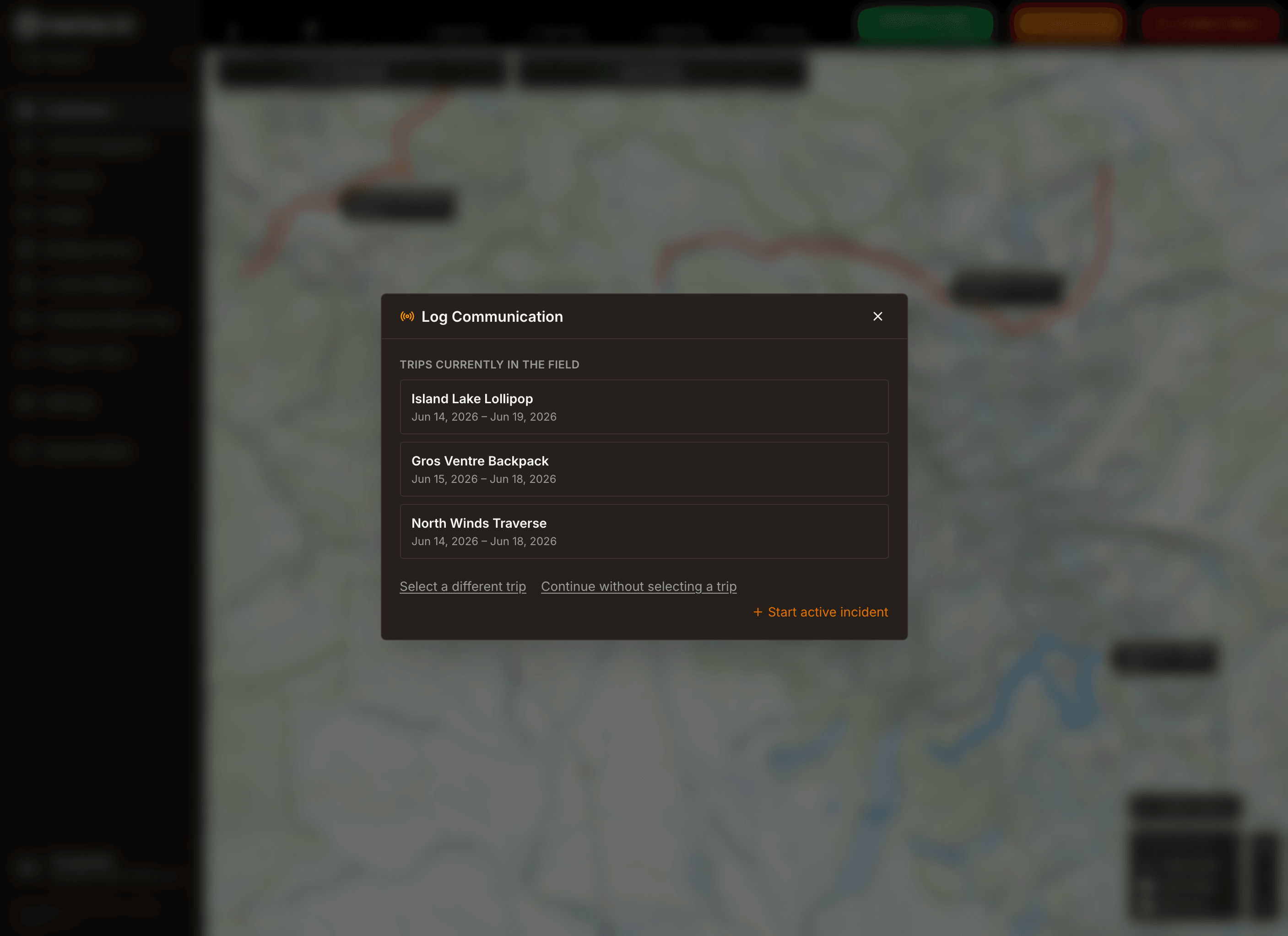
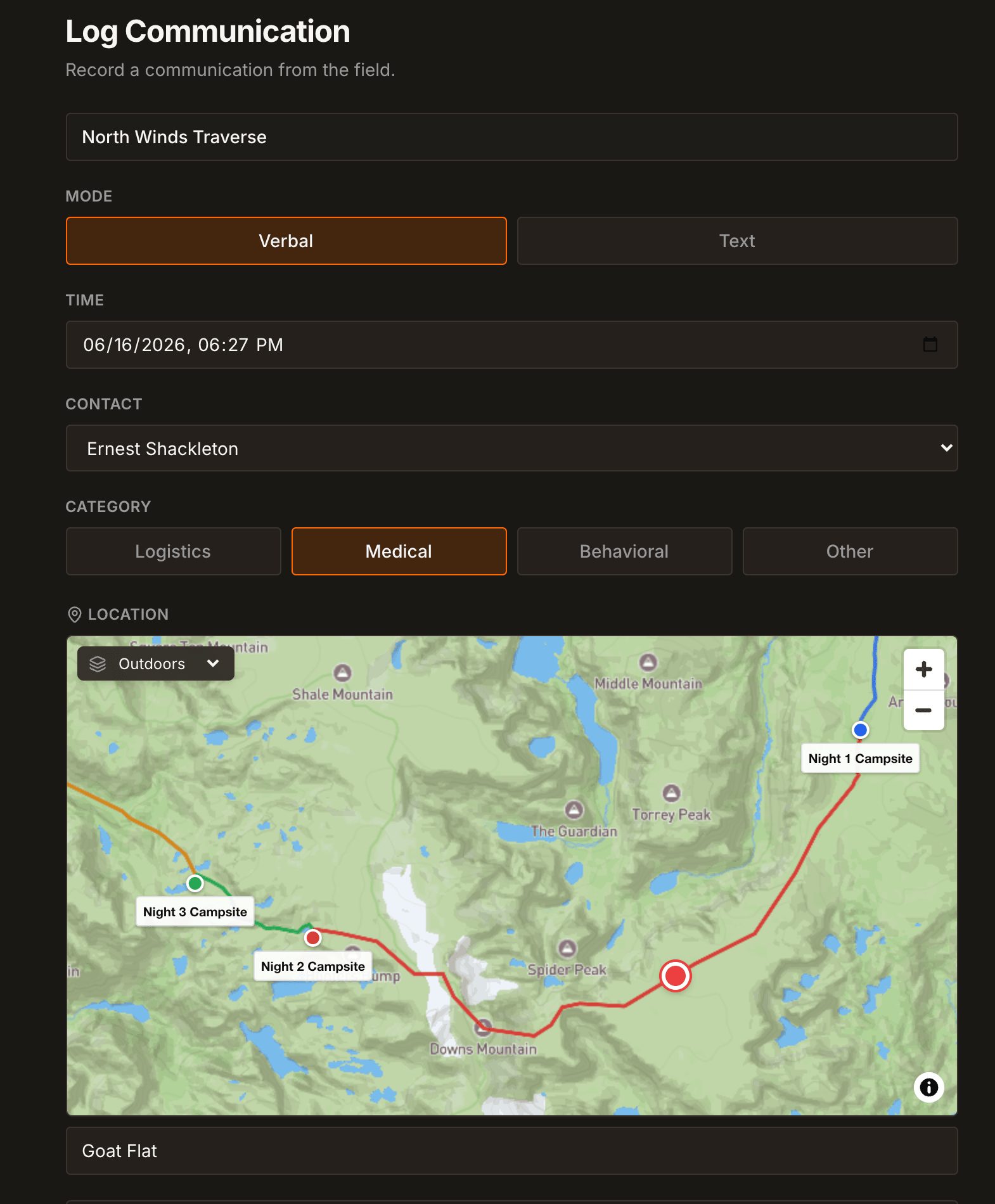
From the dashboard, logging a communication is simple and fast. You select the trip, caller, and call type (medical, behavioral, logistics, or other) and fill in what was communicated and what the initial plan is. Type-specific fields, such as a SOAP note for medical calls, are automatically surfaced, so the person answering the call makes sure they have the information they need. Because it's typed, legibility doesn't depend on your heart rate. Because it's in the platform, every admin and manager with system access sees it in real time.
One part of the Field Risk OS comms log goes directly back to where this story started, the paper. As part of the trip packet that leaders take with them into the field, Field Risk OS generates a printable version of the same in-system workflow the program manager fills out on the other side of the sat phone call. Both sides read down the same page, in the same order. This reduces the mental load on both sides and gives the caller a clear structure for their report and thoughts.
Comms logs can attach to incident reports when they're written, which means the documentation chain from first call to final report is intact and in one place. And when next season comes around, those incident reports, with the full communication logs embedded, are available for review. The lessons don't live in one person's memory or in a notebook that gets lost between seasons. They live in the system.
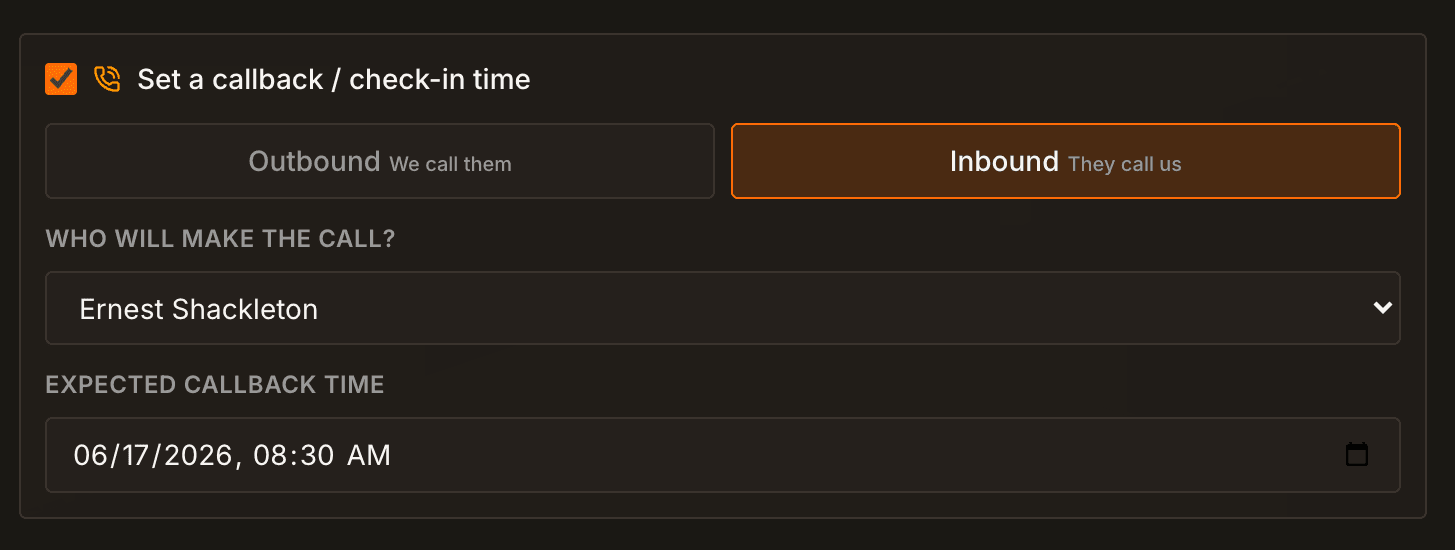
If that specific night had happened with Field Risk OS in place, the leadership team would have seen the call log the moment I submitted it. They'd have known what was communicated, what the initial plan was, and who was going where. And because I would have set an expected check-in time when I logged that first call (prompted by the system, so I wouldn't forget), the leadership team would have known exactly when to expect the next update and seen it flagged the moment it was overdue, instead of sitting in the office for an hour with no situational awareness. If the incident had been more serious, if that documentation had needed to surface in an insurance process or a legal proceeding, a structured, timestamped, legible communication log is a very different thing to hand over than a scribbled piece of paper.
That's the story behind one of the features I'm most passionate about in Field Risk OS. If you run a multi-day expedition program (summer camp, independent school, field-based course, guiding outfit) and you've had your own version of this night, I want to hear about it. These conversations shape the platform.
Related: on Episode 1 of the Field Debrief™ podcast, risk expert Stuart Slay and I break down Airblue Flight 202, an aviation case study in communication, hierarchy, and speaking up when it matters most.
Field Risk OS is a documentation and workflow software for outdoor expedition programs.