Field Debrief Podcast | Episode 2, Part 1
Blame, Accountability, and Trust: What a Van Incident in Utah Teaches Us About Safety Culture for Outdoor Programs
Featuring Steve Smith, founder of Experiential Consulting and author of Beneficial Risks and Safety Science for Outdoor & Experiential Education
By George Bull ·
This episode of the Field Debrief centers around a van incident on a muddy BLM road in Utah. The organization's first response? A drug test for the insurance company.
In the first of this two-part episode, we analyze the incident (and the broader industry) from numerous angles, including reporting culture, the blame cycle versus the trust loop, accountability, safety clutter, and the effects of Taylorism. Part 2 is out now: Safety-I and Safety-II, risk optimization, the zero paradox, and liability avoidance versus operational safety.
Topics
- The Utah van incident: a drug test before "is everyone okay," and the unreported dings and dents that followed.
- Taylorism and the us-and-them culture: where "management thinks, workers do" came from, and its lingering effects a century later.
- The blame cycle (James Reason) versus the trust loop (Clive Lloyd).
- The Deepwater Horizon oil rig, where executives were on board celebrating seven years without a lost-time incident the day it exploded.
- George's first near-miss report, and what a director's response in that moment does to a reporting culture.
- Rewards for not reporting, personal first aid kits, and "___ days since our last on-the-job injury."
- The mirror in the box: "you and only you are responsible for your safety" and the false binary it creates.
- The five whys, the myth of a single root cause, and Todd Conklin's description of accountability as an act of clarity.
- Safety clutter.
Meet Steve Smith
Steve Smith is the founder of Experiential Consulting, LLC and has worked in outdoor education for more than 30 years. He's held positions with Outward Bound and the Student Conservation Association, where he served as national risk management director. Steve chaired the Wilderness Risk Management Conference from 2014 to 2016 and has served on accreditation and risk management committees across the industry. Today he and his team consult exclusively with outdoor and experiential education programs, from camps and guide services to outdoor education and wilderness therapy organizations. Steve is the primary author of Beneficial Risks and Safety Science for Outdoor & Experiential Education, and the host of the Were We Lucky or Were We Good? podcast. He holds a master's degree in teaching English and a Professional in Human Resources certification, and lives in Langley, Washington. As Steve puts it, his team likes to do safety with people, not to people. Steve Smith is also featured in Part 2.
Key Diagrams from the Episode
The Blame Cycle
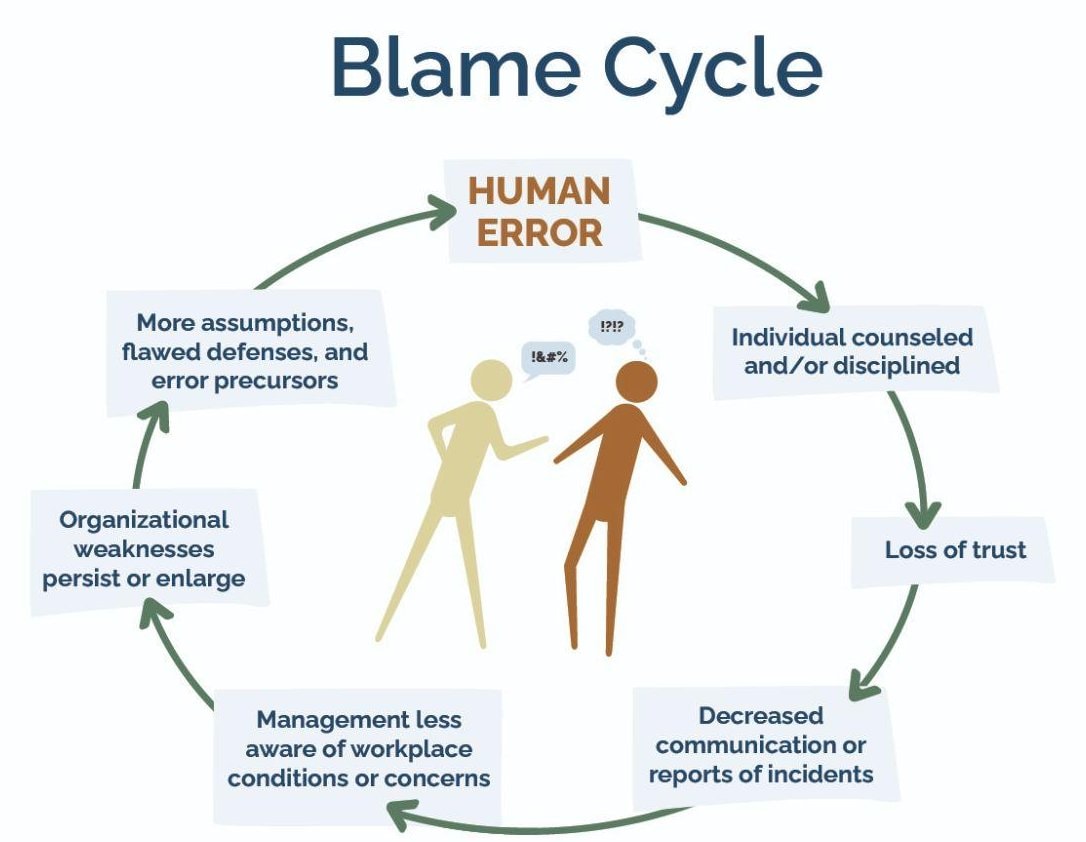
James Reason's blame cycle describes what happens after an incident when an organization believes people are the cause of its safety problems. Someone is counseled, disciplined, or retrained, trust drops, reporting dries up, management loses sight of real workplace conditions, and the weaknesses that produced the incident persist until it happens again. In the episode, Steve traces the Utah van organization's drug-test-first policy around this exact loop.
The Trust Loop
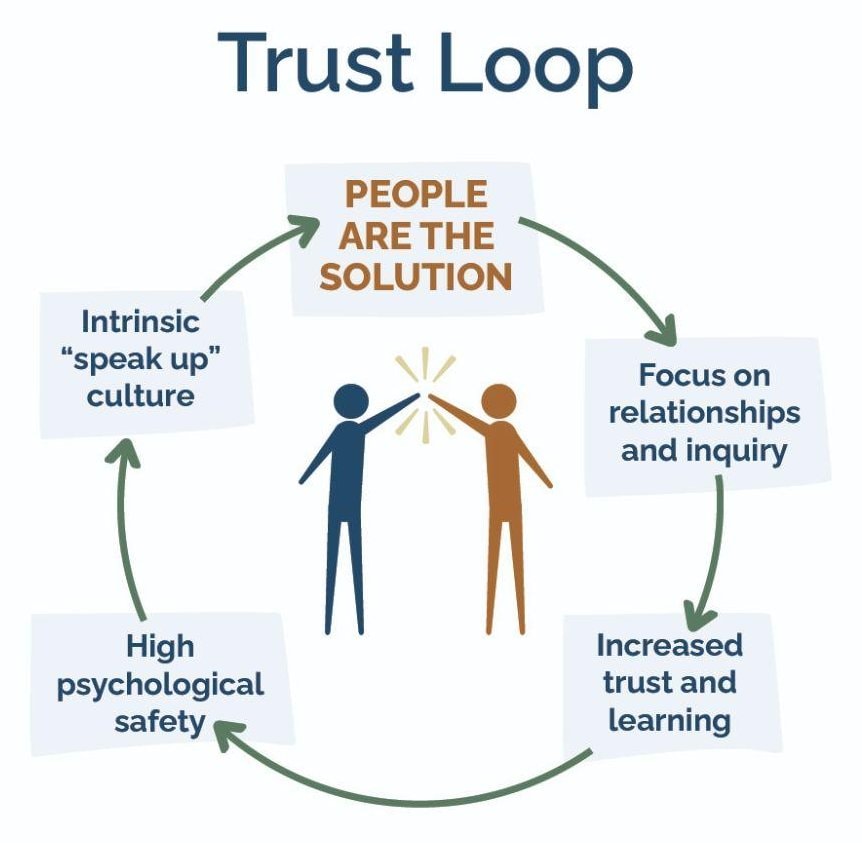
Clive Lloyd's trust loop starts from the opposite belief: people are the solution to our safety problems. When speaking up is safe, concerns surface early, conditions get fixed, and reporting and learning compound.
The Swiss Cheese Model
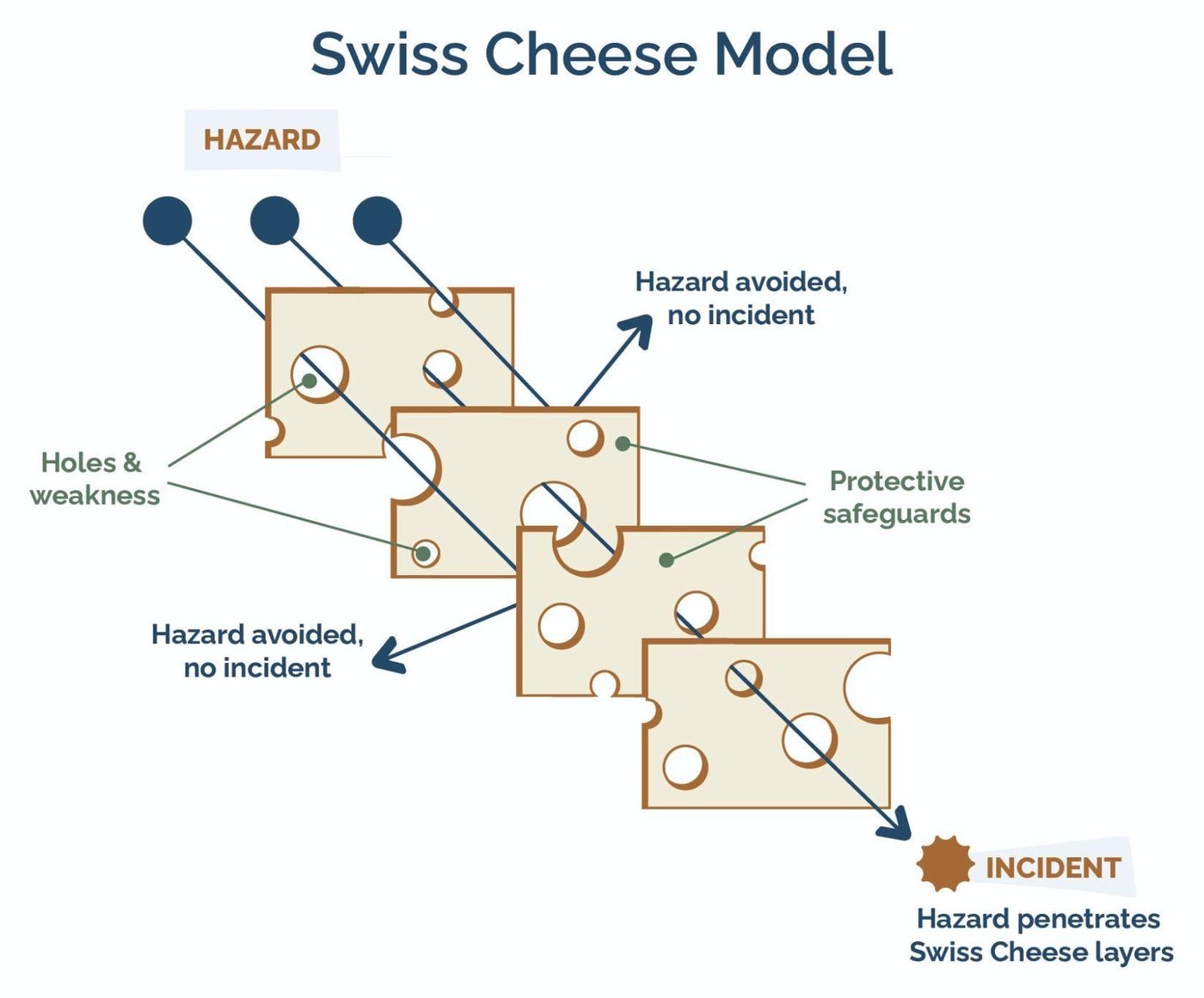
Reason's Swiss cheese model frames an organization's safeguards as slices with holes. No single layer stops everything, and incidents happen when the holes line up. It remains the most widely taught model of incident causation in safety-critical industries, and it sits behind the episode's discussion of why a single root cause is a myth.
People Mentioned in This Episode
- Frederick Winslow Taylor: the engineer behind early twentieth century scientific management, better known as Taylorism, whose us-and-them worldview the episode traces into modern safety programs.
- James Reason (1938 to 2025): British psychologist and longtime professor at the University of Manchester whose research on human error gave safety science the Swiss cheese model, the blame cycle, and much of its vocabulary. His books include Human Error and Managing the Risks of Organizational Accidents.
- Clive Lloyd: Australian psychologist, co-director and principal consultant of GYST Consulting, and developer of the Care Factor Program. His book Next Generation Safety Leadership: From Compliance to Care frames the move from fear-driven blame toward the trust loop.
- Todd Conklin: spent 25 years at Los Alamos National Laboratory as a senior advisor for organizational and safety culture and is one of the leading voices in Human and Organizational Performance. His books include Pre-Accident Investigations. Steve borrows his description of accountability as an act of clarity.
- Sidney Dekker: professor and director of the Safety Science Innovation Lab at Griffith University in Brisbane, and a pioneer of Just Culture and the Safety Differently movement. He wrote the forewords to both of Steve's books, Beneficial Risks and Safety Science for Outdoor & Experiential Education, and co-authored the safety clutter research.
- David Provan: safety scientist at Griffith University's Safety Science Innovation Lab, co-author of the safety clutter research, and co-host of The Safety of Work podcast with Drew Rae.
- Drew Rae: safety science researcher at Griffith University's Safety Science Innovation Lab, co-author of the safety clutter research, and co-host of The Safety of Work podcast.
Resources and Further Reading
- Experiential Consulting: Steve's consultancy, and where to find Beneficial Risks and Safety Science for Outdoor & Experiential Education. The illustrations in this episode are from Safety Science.
- "Safety clutter: the accumulation and persistence of 'safety' work that does not contribute to operational safety" (Rae, Provan, Weber, and Dekker, 2018): the paper behind the safety clutter discussion.
- The Safety of Work podcast: Drew Rae and David Provan review safety research question by question.
- Sidney Dekker's site: books and resources on Safety Differently and Just Culture.
- Clive Lloyd at GYST Consulting: the trust loop and care-based safety leadership.
- Pre-Accident Investigations by Todd Conklin: an introduction to Human and Organizational Performance.
- James Reason, 1938 to 2025: the Flight Safety Foundation's remembrance of his life and work.
Field Debrief™ is produced by Field Risk Systems™ LLC, the company behind Field Risk OS, The Operating System for Expedition Programs.
More from Field Debrief
- Episode 2, Part 2: Safety-I, Safety-II, and Risk Optimization for Outdoor Programs
- Airblue Flight 202: A Human Factors Disaster
- My First Sat Phone Call as an Outdoor Program Manager
- Designing a Trip Planning System for Outdoor Expedition Programs
Episode Chapters
- 00:00 Welcome, and how Beneficial Risks reached Antarctica
- 02:17 The Utah van story
- 05:24 Fix the worker or fix the workplace
- 09:25 Taylorism defined and the us-and-them culture
- 14:17 Trust, the blame cycle, and Deepwater Horizon
- 18:06 A first near-miss report
- 19:51 Rewards for not reporting
- 23:10 The trust loop
- 25:25 The mirror in the box
- 26:19 Accountability versus blame
- 32:06 Safety clutter and the 27-item checklist
Transcript
Recorded August 6, 2026. Lightly edited for clarity.
George Bull (00:00): Hi everybody, welcome to episode two of the Field Debrief Podcast. Today I am going to be joined by a colleague, mentor, and friend of mine, Steve Smith. Welcome to the podcast, Steve.
Steve Smith (00:12): It's so good to be here with you, George. Thanks for the invitation and just yeah, looking forward to having this conversation with you.
George Bull (00:19): Yeah, it'll be a fun one. Steve is the founder of Experiential Consulting, a risk management and consultancy that uniquely works with outdoor and experiential education programs. He's written two books that provide foundational concepts for anyone working in our field. Much of our talk today is gonna draw from those two books. So his initial one, Beneficial Risks, and the newest one, Safety Science for Outdoor and Experiential Education. this newest one looks at what we've learned from safety management in many complex and hazardous industries and applies it to our field. I've been having a great time with the second one. But before we hop into our debrief today, I do wanna mention briefly, I think in 2022, when I was down in Antarctica at McMurdo Station, I reached out to Steve and I had read some blog or something that he'd done, and I was like, whoa, this is really cool that this exists as a profession doing safety science for the outdoor industry. And I reached out to him and we had a great conversation. And he ended up sending me the beneficial risks book down on the ice. And I read it down there. And if you dig back on my LinkedIn, there's a picture of Kate Koons and I holding it at the lab at McMurdo. So thank you, Steve, for introducing me to safety science. I appreciate it.
Steve Smith (01:44): I do remember that. and that wonderful photo that came all the way from Antarctica of you two with my book. and I remember sharing that on LinkedIn and just all the, you know, kind responses from folks. And so, you know, I've been a big fan of you, George, as well, ever since we first crossed paths, you know, virtually back in 2022. So yeah, where would you like to where would you like to go today?
George Bull (02:08): Well, in the theme of the field debrief, let's debrief something. I think you have an incident in mind to talk through.
Steve Smith (02:17): Yeah, I have a story that sort of sets the stage, I think, for a lot of the different things that we can talk about here today. And I'll be interested to see where you go with this, but it's a true story about a single vehicle collision, a solitary employee of an expeditionary wilderness program. let's say they're on a remote muddy, you know Forest Service or BLM Road in let's pick some place like Utah. And say that it was a single vehicle collision, meaning that the driver went off the muddy road and you know damaged the vehicle, but was still able to get it back into town and rolled into town with the incidents you know having occurred. And the organization's first response to this event is what's interesting. And it was not to ask if everyone was okay, it was not to ask, you know, as I imagine. You might, George, it doesn't tell me more about what was going on that might have contributed to the crash or made it possible not to be curious and say something like, you know, was this a surprise? Did you see this coming in some way? What can we learn from this? The first response to the incident was to ask the driver to pee in a cup so that they could do a drug test and have those results that they could share with their insurance provider. And that was the first instinct that they had. And it was following a policy that the organization actually had firmly in place, a written policy that this is the most important first response that we need to have when something like this occurs. You know, assuming that there's no 911 call or someone on their way to the hospital. So, you know, in that story. I think we see a lot of really interesting things that we can unpack about safety science and what it tells us from the details of looking at this story. But interestingly, shortly after that drug test policy was introduced at the organization and they started following it, interestingly, they started noticing dings and dents and things like this on the vehicles that had not been reported formally, and they were just noticing vehicles that were coming back with damage and dings and dents and stuff like that they couldn't account for. And gee, I wonder why, right? So you know, I think that's an interesting little part of the story too. And yeah, where would you like to go with that story?
George Bull (05:02): Well, I mean first of all on the human level, there's a lot of you know things we could talk about with the first, you know, topic after an accident being, hey, will you pee in this cup? But kind of moving past that to the safety science or organizational level, what comes up, like what's on your mind? What's the first thing this makes you think of?
Steve Smith (05:24): Yeah, so many things. You know, and I think at the core I probably have about four things I wanna talk about, but the core thing, the really interesting thing that emerges, is this underlying belief. It's the idea that people are the cause of our safety problems. It's not the equipment, it's not the policies, it's not the schedule they're operating on or the group that we provided them or the policies or the flawed vehicle that we gave them or driving at night or any of that stuff, right? It's the people. And so if we believe that at our core belief that people are the cause of our safety problems, that's where we're gonna focus our efforts. At asking questions that are about the people, not about that other stuff. And focusing our corrective actions at the people and not that other stuff. So we need to locate the bad people, find the bad apples. You know, who should we blame? Who should we shame? Who should we retrain? You know, that kind of mindset. And we're going to put all of our effort on trying to fix this broken component of our system, the people, instead of asking a different question, which is, what were the conditions that made these errors more likely to happen? And could they have happened to someone else just as easily as they happened to this person? And instead of focusing on fixing the worker, maybe we could think about fixing the workplace. because I'm pretty sure that employee didn't wake up that morning with the intention or the plan or this crudely formed idea that I think I'm gonna wreck the car today you know, so telling them that they need to care more and try harder and not wreck the car. looks good on paper because it seems like we've checked that box and we've made the insurance company happy and you know as a manager you can feel like well I've done my you know I've done all I can and I've told them not to wreck the cars. But is that really gonna meaningfully make a difference and keep that keep that person you know, from going off the road like they did. So, you know, I think that's the first thing that comes up for me when I tell that story is just realizing that, you know, everyone in the story was doing their best, whether it was the manager or the organization following their own policy or the driver who made a mistake or the vehicle that wasn't properly maintained. Everybody was doing their best, but we are looking at this through the lens of assuming that the system is good, it's the people that are the problem. And yeah, what do you think of that?
George Bull (08:18): Well, think it's not only that you're focusing on the human part of the system, but it's you're assuming that the human part of the system broke in a negligent way. That this like not even that it's like I think there, you know, there's I'm personally a really big fan of like human factors centered. Incident debriefs. Like I think inherently a lot of incidents, a human is involved in. That's sort of what makes it an incident. But they're a part of that whole system. And so this really feels like it's not even investigating the person as a component of the system, but it's like, this person did something negligent. they did something potentially purposefully wrong. Or
Steve Smith (09:00): Yeah, yeah.
George Bull (09:01): like you said, like they definitely didn't plan to go off the road in a van that day. Like I think that's sort of table stakes. I know a great quote that I heard you say once is sort of like compliance is the baseline. Like we're like as a safety science world, we can probably move past thinking about, well, were they compliant when we think about an incident investigation? And so this to me feels a lot more like Taylorism. Which I imagine you're very familiar with Taylorism, but it's the early 20th century idea that management is just about essentially telling people how to do things and making sure that they do it in the right way. And it could create this hierarchy, but what do you think about how this how this relates to Taylorism?
Steve Smith (09:49): Yeah, it's an excellent connection to Taylorism. And you know Taylorism arises from a book that Taylor wrote back in the 20s during the time when you know the industrial revolution was giving us an opportunity to suddenly have something that we had not really had in this way in the past, which was these large organizations with lots of frontline workers that needed to report up to management. And it created either the opportunity for us all to be on the same team or for humans to do what humans do and to divide things into two groups. And when we divide things into two groups, interestingly, there's often an implication or an assumption that one group is better. And we see this, you know, in lots of different ways, but in this case. It was a worldview that management was fundamentally different than the frontline worker. They they were different in every way, not just in their skills and abilities and their education, but in their morals as well. And it was this idea that the frontline workers needed to be watched and supervised and corrected or even punished because at their core they were morally different than management. And so it established this belief system that continues to this day and is still present with us in a lot of the ways that we see corporations set up, we see unions that are formed in order to push back against this belief that there are these two classes of citizens in an organization. We see it in the way that contracts and non-compete clauses and lots of things are set up that we normalize. And it's founded on this platform of Taylorism. This us and them is how I would describe it, an us and them culture. You know, we did everything we could. We told them not to wreck the car, we gave them the training, they signed page 49 of the employee handbook that said, I will agree to all of your policies and I will not wreck the car. And lo and behold, the car was still wrecked. And so what do you think? Was it was it who should we blame? You know, and just this foundational. The two things that I just described there, you know, this belief that humans are the problem, the system is good and humans are the problem, and specifically it's the frontline workers that are the real problem, if we have to be honest. You know, these are
George Bull (12:29): Yeah, like there's a right way to do it and any problem is them not doing that.
Steve Smith (12:34): exactly not following. Not following what we told them to do, what the policy said to do, what we trained them to do. And so it's this fear of variability, this idea that when people deviate from what the perfect plan that we gave them, the perfect policy, the perfect workplace system, when people deviate, that itself is automatically not only a moral failing, but it's making us less safe. And that's the reason why that X occurred, right? So it's this deeply seated, it's a deeply seated thing that we have that we are so surrounded by that we might not even see it unless we look for it in this in this way. Unless you think about Taylorism and you think about this us and them culture. And what is the effect in an organization on your safety management systems if everything about safety comes from the top down it is safety and accountability that workers have up towards the management or is it a responsibility that management and the organization has down through all the human beings? That work in that organization and how you answer that question, you know, makes a real difference in sort of how what you can learn from and how we can prevent future events like this from happening. So that's a really big one that you just pulled out of the Utah vehicle story. So well done on that.
George Bull (14:17): So I wanna keep pulling on this thread here with kind of that us versus them mentality. Something I've been reflecting on which is like, what is risk management? Or like When do you start doing risk management, right? And when we think about trust, I think there's lots of things at an organization that maybe don't feel like they would have an impact on safety. But might in a negative way. And so what are some examples that maybe you could think through where lack of trust or that us versus them hierarchy, maybe doesn't feel like you know this is affecting risk management, but actually just portraying this lack of trust might be.
Steve Smith (15:01): Yeah. It's such a good one. And it's actually kind of like, you know, I named the second book. I called it Were We Lucky or Were We Good. But I could also imagine a subtitle that has something to do with trust. Because I think the concept of trust is a central theme that runs through almost every age of safety that we talk about, the evolution of safety. And you know, a simple way to talk about that is one of the models that we contrast in the book is comparing something called the blame cycle versus the trust loop. And we'll talk about those two things separately. Think about the Utah van story and how management's response to it drove reporting and future learning and prevention underground by making an unsafe space for people to share. By the way, I had an incident or I backed the van into a pole or whatever. Because they made an unsafe space and they blamed and shamed and they saw people as the cause of their safety problems, it drove reporting underground. It led some of those organizational conditions that caused may have contributed to the incident to begin with to continue to persist, and thereby other people fall into that same trap, and the blame cycle continues to keep us in this place of hiding things and not correcting things. And it's sort of like the story, you know, in a dramatic way, it's it's the story of the Deepwater Horizon rig in the Gulf of Mexico that famously blew up, causing not only you know fatalities and lots of injuries, but a massive ecological consequence as well to the Gulf that they're still recovering from today. But that same oil rig that blew up had won an award that same week. And executives from the ownership had flown in for a photo op on the oil rig,
George Bull (17:07): Really?
Steve Smith (17:08): winning an award for six, seven years with zero reported incidents. Now let me ask you, in that environment, doing that work in that incredibly dynamic, you know, environment, do you believe that they had zero incidents, zero injuries, zero near misses during those seven years? Or was there something going on in the organizational culture, you know, that was making it harder, perhaps, for people to speak up and report those things when they were happening? I know which one I believe, right? And so this is how the blame cycle works, right? It it looks safer on the surface, and it's making us less safe, insidiously less safe because of the organizational dynamics, if that makes sense.
George Bull (17:56): I cringe every time I watch like a you know an 80s or 90s movie where you see the like blank days since last incident sign up on the wall. And I'm sure those are probably still kicking around today. Like it sounds like it with Clearwater Horizon, like or Deepwater Horizon. And that definitely creates a culture where it feels like a really big deal to have a near miss. Like what you describe with executives flying out to the to the oil rig and celebrating, you know, seven years with no issues, that's gonna make reporting an issue feel like feel like something that's a really big deal. And and it's gonna feel like almost a loss or a big negative to To report that issue. And so I think that's certainly a psychological barrier between someone and their willingness to report a near miss. I mean, I have a personal experience I can remember where I had a near-miss like pulling out of an exit in a in a in a van, and I a truck was going really fast and got a little bit too close to me. And I went to the director of organization and I was like, I felt a little nervous to file my first near miss. I was, I don't know, 20 at the time, and I was like, Hey, this happened, like I felt like it was kind of a near miss, should I file it? And that the director was like, absolutely. And that was, I felt really lucky, like, wow, this like this is real. You know, you talk about it in staff training if there's a near miss, you need to file it, but that's not real until people actually file those near misses. And so if there's a sign on the wall or an executive, a parade of executives celebrating no issues for the last seven years, you're really not gonna wanna be either the frontline worker or in the Taylorist view, the manager that is the one reporting a near-miss up the chain.
Steve Smith (19:51): Exactly. And and maybe there's even not only is there fear of reporting, maybe there's rewards for not reporting. Maybe your team gets a pizza party at the end of the month for getting through that work month successfully with no injuries. You know, I've seen situations where people at a work site were all walking around with their own little personal first aid kits on a little fanny belt around their waist. And my first instinct was how great. They are trained in first aid. They are agile and prepared to help themselves and each other should something happen. What a risk-aware, well-prepared organization. And then, you know, you see the sign on the wall, you know, 375 days since our last on-the-job injury. Who wants to be the one to speak up and say, I got hurt at work today? And wouldn't it be easier to just go behind the trailer or back into the woods and bandage up your own wound and pop some painkillers and come back to work with this bandage hidden underneath your long sleeve shirt and continue your job, you know? Right? And so is safety even effectively measured by studying what has gone wrong? A, because we're hiding it to begin with under that under that construct. And B, is that even the entirety of the story? Like can we understand safety? By only looking at those times when we were in fact not safe? Is that the place where we it's like you know, the metaphor I'm I think you've heard me say is, can we understand happy marriage by only studying cases that have ended in divorce? How can we study safety and understand it and manage it by only looking at those rare, relatively rare instances when we were in fact not safe? So how can we expand our lens? And how can we perhaps shift from this blame cycle. Let's contrast that with the other option, which, you know, the blame cycle concept was introduced by James Reason. you may remember him from things like the Swiss cheese model of incident causation, a brilliant safety researcher and thinker who just died actually less than a year ago after a remarkable career with many contributions to our field. Building on or contrasting with reason's blame cycle, another wonderful thinker and contributor and researcher in our space is an author and organizational psychologist named Clive Lloyd, who created something called the trust loop. And you know, I'm sure with your skillful facilitation of your podcast, you'll pop up the blame cycle for people to see, and you can pop up the trust loop for people to see. So I'm gonna imagine it right here. Over my shoulder right now, or maybe over here. And the trust loop, instead of starting with the premise that people are the cause of our safety problems, what if we start with a different belief? What if we start with the idea that people are the solution to our safety problems? And from there, we can go around this virtuous cycle of sharing our concerns and speaking up when we have an issue and creating psychological safety in the workplace and thereby, you know, correcting and fixing some of the conditions or the broken pieces or whatever the workflow issues may be that are making these events possible to begin with. And we're in this virtuous cycle of learning and continuously improving and not waiting for a bad thing to happen and then hiding it. So it's clearly a better way to work. But it's easy to say. It's easy for you and I to sit here on this podcast and talk about that. And organizations don't just drift their way into a trust loop. It's not just something that naturally arises. It it requires Organizational clarity and commitment and an understanding that the blame cycle, which might be more of a intuitive, it might be more of our default. I think a lot of organizations start with a blame cycle unless you replace it with something else. And so, you know, with it when an organization does the work and makes a trust loop possible, then that's that's the beginning. But there's also an interesting piece which is it has been said that it has been said that trust arrives by the drop and it leaves by the bucket. Meaning, you know, that it's hard to build and really quick to dismantle. Like the first time you submit a near-miss, you know, about that vehicle incident you mentioned, and then you get blamed and shamed or punished, or people are talking about you rather than to you, or maybe you get demoted, or maybe they make you stand up in the all-staff meeting and share the story in some humiliating way about how you should have cared more and tried harder. and paid more attention and how you'll be better in the future. or maybe they have a safety stand down, you know, where like no one is allowed to drive vehicles for twenty-four hours as punishment for the incident that George reported. Have you seen the thing where, you know, there'll be a little box and someone walks into the job site and the box will say, open this door to see who is responsible for your safety at work. And you open the little box and there's a mirror and of course you see yourself. And the message is that you are you are responsible for your safety and only you are responsible for your safety and I can kind of see some logic in that but the problem is it presents it as this binary thing right it presents it as you and only you are responsible for your safety as opposed to the you know it's not workers or systems it's workers in systems. It's a very interconnected thing and I think we create these false binaries by putting it in one or the other when it's really both.
George Bull (26:19): I was talking to a colleague and a safety professional in the utilities industry over coffee the other day, and we were discussing sort of trust versus blame when it comes to incidents. and he had mentioned that there is some value in his view of accountability and I think from my personal point of view, like I don't know that I would wanna work in an organization. Where there's no accountability, like where someone could do something negligent and the organization is so in the in the trust loop, at least like the way I understand it, that maybe like that there the corrective action that maybe should be taken isn't, or along those lines, like what do you view as like the intersection of a trust cycle and personal accountability?
Steve Smith (27:13): Yeah, wonderful. Thanks for that. That's great. I agree. I would not like to work in a place and the way you kind of painted the picture is sort of this workplace with no boundaries and no sort of amnesty for everyone, right? And people can do whatever. And I think that it is very useful to think about how we as an individual and how we as a society define blame and how we define accountability because I believe we use those terms pretty interchangeably. And it is useful to consider might there be a difference between blame and accountability? And a simple way to think about this is looking backwards or looking forwards. There is a really a lot of what we've described in this podcast so far, and a lot of kind of how traditional top-down safety management works, is a backwards looking blame approach. or yeah, it's a backwards looking blame approach that starts with the incident, the event that occurred, and it works its way backwards in time as far as you need to go in order to identify or find a cause. That you can agree on, something that's understandable, simple, identifiable, fixable, most importantly, right? We want to find a cause.
George Bull (28:43): Hopefully there's only one.
Steve Smith (28:45): Yeah, yeah. And and the whole idea of a root cause, the myth, the fallacy of monocausality, right? This idea that there is a single cause, and we just need to go back far enough to find it. There's a there's a framework that a lot of people relied on for a long time. called the five whys you ask why five times like the vehicle went off the road why the driver was tired why because he'd worked a long shift why because they were having staffing challenge blah so you can kind of just work your way backwards through this set of questions and the idea was five was about the right number that was going to get below the proximal cause Of the event, like making the wrong turn and get to the underlying cause of the event, which was usually some kind of human error that was going to involve shaming, blaming, training, or firing the person. And this belief that You know, we can we can identify a cause and fix it. So if we start at the event and we work our way backwards in time to identify the fixable cause, which is instead of five whys, you might kind of simplify it to one who. Who was to blame, right? so we've we've worked backwards in time, we've found someone to blame, and we've identified the things that happened there. And what if instead of doing it like that? What if we think about forward-looking accountability instead of backwards-looking blame? Forward-looking accountability meaning asking some different questions. Like, what's going to keep this from happening again? And maybe even things like who was hurt and what do they need? And how can we help restore whatever got harmed in this event by collectively committing to understanding what were the conditions that made these incidents more likely to occur that we can all work on together. to keep them from happening again. So looking forward into the future is going to lead to a very different kind of set of answers and a very different kind of possibility for learning from it. It's an opening rather than a closing, right? The backwards looking blame is like we're gonna close the case. We're gonna answer what was wrong, we're gonna fix the problem, we're gonna find the broken component, as opposed to maybe the less comfortable but more useful place of we're not entirely sure, but here's what we think we need to do to move forward together. We're not hiding things, we're exploring and learning together and working together as a team. So, like Todd Conklin has described accountability, knowing who do I go to, who do I ask for help, who's got my back. He's described it as an act of clarity, which I find to be a beautiful way to describe that. So, you know, this is a useful way for us to think about the language that we use in forming the possibility of how we can learn together from something like that.
George Bull (32:06): that's a great way to look at it. Thank you, Steve. Another piece that I want to talk about in relation, especially to something like van safety or this Utah van accident, would be the concept in your book of safety clutter. What type of safety clutter would you expect to see at maybe, you know, an organization that would be taking children in vans and where you might see this type of event?
Steve Smith (32:35): Yeah, wonderful. So thanks for that. Great. I love that you brought up that topic. And multiple people have written about this, but there was a very clear and useful and more recent paper on it by people like Drew Rae, David Provan, Sidney Dekker writing about safety clutter. And the idea of safety clutter is stuff that accumulates over time. Our safety management systems tend to get bigger and bigger and bigger. It's always easy to add a new policy, add a new rule, add a new piece of equipment, add a new procedure. But whose job is it to take things away? And how does that accumulated safety clutter begin to look more like what David Provan has called the work of safety. He makes this useful distinction between the safety of work and the work of safety. The work of safety being sort of a pejorative term about the clutter itself. Looking good and checking the boxes and filling out all the paperwork and spending your time focused on compliance, rather than care, right? you know, looking at yeah, cluttering things up with more rules, more regulations, more paperwork, more process. To follow. And you know, to me, Safety Clutter is sort of epitomized by the idea of a manager who is in the office on their computer filling out documents in triplicate for different audiences because the rules or the contract or the conditions under which they're working require them to be doing paperwork instead of things that would actually make them safer. So is it are we trying to appear safe or are we trying to be safe? And instead like you might ask, well how was the job site today? How were people doing? what happened on the job today? Did you have any incidents or near misses? And they have no idea because they were in the office with their head down filling out forms instead of actually walking around helping, assessing, being a resource, helping people adapt. And so it's this pursuit of looking good rather than actually being good, you know, which is to me the essence of safety clutter. the most obvious example that I often see that could have been part of it could have been part of the Utah story is the idea of some checklist that the organization, the workers have been provided. And let's imagine that it was handed down to them by an insurance provider. Or by, you know, someone in a risk management role in an office who doesn't drive the actual vehicles in the field with the participants every day like the workers do. And so it might have this meticulous list of 27 different things that you need to check before you're allowed to turn the key every single time you drive the vehicle. And a form that you actually have to check these boxes and initial it and date it and say that you have checked things like tire depth tread and wind windshield washer fluid for front and back, and looked, walked all around the vehicle and inspected every tire for nails and all these things. And this might be something that you would if you follow the rules, you have to do this ten times in a given day every time that you start and stop that vehicle. because the rules say so. If you were a twenty year old newly hired, you know, outdoor educator working in a camp or someplace, I'm gonna guess that you might dutifully do that the first nine days, ten days, maybe eleven days that you work there. But at some point, you know, it's kind of reasonable to ask this question. do you want me to follow the rules or do you want me to get them to camp before midnight? Because I have to pick. I have to pick one or the other. Right. And so, you know, safety clutter is something that it doesn't make us safer. It can make us less safe because it's distracting us from doing the things that we should be doing. And it's also teaching us that we don't need to follow all the rules, we can cut corners where we need to, and that we the workers are beginning to sort of make up their own version of what's important and what's not. And there can be this gap between what we think is happening and what's really happening. This is what we call work as imagined and work as done. And there that's such a useful place to look if we want to understand, or it's a it's a way of looking at what's happening in the field, work as imagined and work as done. And it doesn't mean that work as done is wrong. It might be an improvement, it might be a workaround, it might be something that the workers have figured out that's better than what the rule book says, but it can also be a way that we can kind of drift in some dangerous directions in ways that are unrecognized, you know. So it's really an interesting It's a really interesting way to look at operational safety, not through this Taylorist lens of bad people breaking rules, bad people breaking perfectly written rules, but more like, maybe we don't have a people problem, maybe the rule is what's bad. Maybe the checklist is overly meticulous. Maybe we need to, you know, learn from work the difference between work as imagined and work as done.
Part 1 ends here. Continue to Part 2.
Common Questions
What is the blame cycle in safety science?
What is the trust loop?
What is safety clutter?
What is work as imagined versus work as done?
Keep Reading
Wildfire Entrapment Avoidance for Outdoor Programs
Featuring Brendan Madden, Director of Enterprise Risk at Girl Guides of Canada and author of An Exploration of Wildfire Entrapment Avoidance for Led Outdoor Activities
Read more →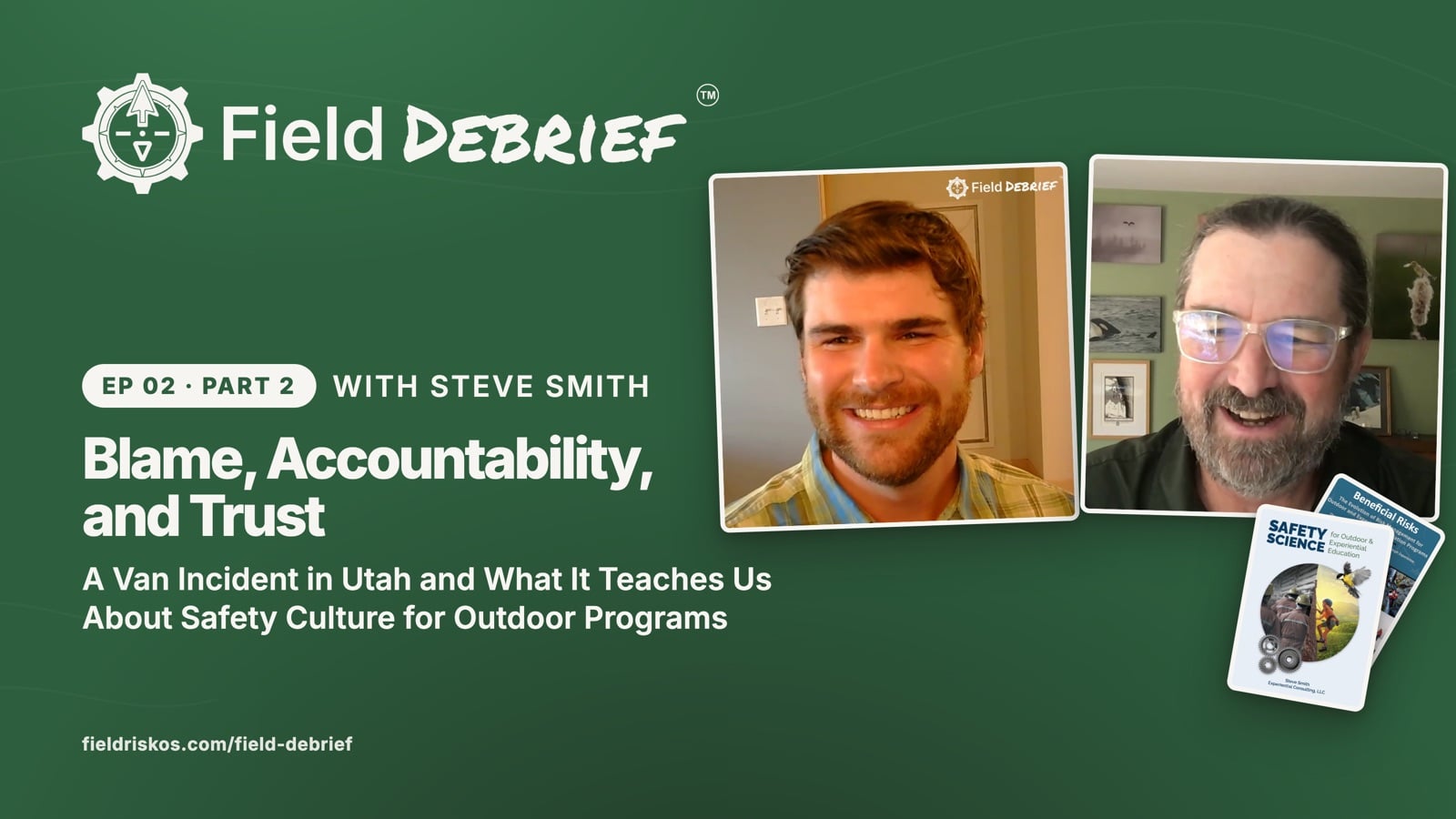
Safety-I, Safety-II, and Risk Optimization for Outdoor Programs
Featuring Steve Smith, founder of Experiential Consulting and author of Beneficial Risks and Safety Science for Outdoor & Experiential Education
Read more →Subscribe to the Newsletter
Founder, Field Risk Systems LLC
George is the founder of Field Risk Systems and the creator of Field Risk OS, an operating system for expedition programs. He has worked as a trip leader and program manager for backcountry expedition programs, as a field coordinator with the US Antarctic Program, and as a commercial guide in Alaska.